Prickly on Purpose · Ep. 1 · 20 min
From Kerala to YC: Avinash on What Not to Build
Published on YouTube
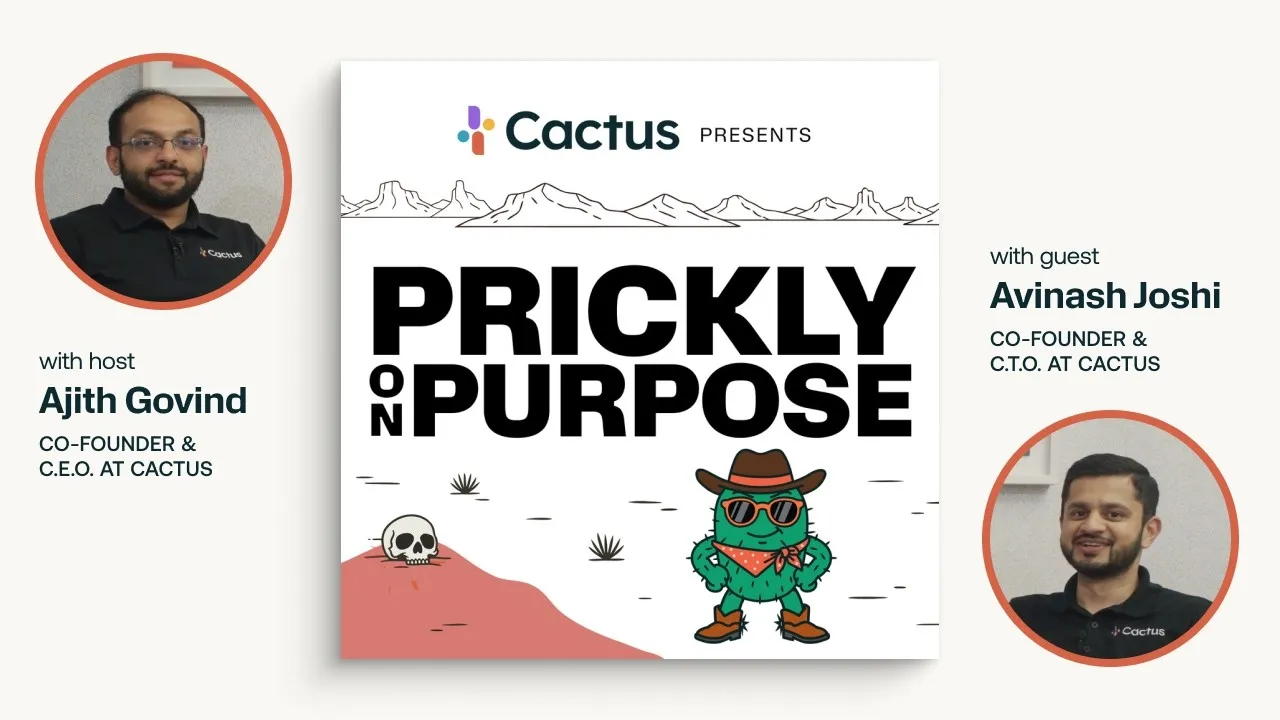
Why doesn't every customer request become a feature? In the first episode of Prickly on Purpose, Cactus CEO Ajith sits down with co-founder and CTO Avinash to talk about what not to build, and the path that led them to start Cactus together.
In this episode
- How Ajith and Avinash met as computer science classmates at Amrita University in Kerala, and how Avinash reached JavaOne 2009 in San Francisco as a Sun Microsystems campus ambassador
- Avinash's three product principles: don't build every request, build fast enough to learn, and avoid piling on toggles and sub-apps
- Why what customers want and what they need are not always the same, and how patterns in requests decide what gets built
- Why a product's inner workings matter as much as its surface, compared to plumbing work hidden behind the wall
- Advice for engineers thinking about leaving a corporate job, and the kind of engineer Avinash wants to work with
Chapters
The write-up
In the first episode of Prickly on Purpose, Cactus co-founders Ajith and Avinash sit down for a candid conversation covering everything from building software to their journey from college classmates to co-founders.
Ajith, Cactus C.E.O, asks Avinash, Cactus co-founder and C.T.O, to name the principles that guide his product thinking. Avinash offers three: do not build every request, build fast enough to learn, and keep the product focused.
These are Avinash’s views from the conversation, not a feature announcement or customer case study. Together, they reveal the tensions behind deciding what belongs in a product and what does not.
A partnership that allows disagreement
Ajith and Avinash first met while studying computer science together in Kerala, a state on India’s southwestern coast. After college, their paths separated until a shared mentor brought them back together at an earlier startup, where Avinash joined as a founding engineer. Years later, they built Cactus together.
That history gives them room to disagree. Avinash is candid that he does not question only customer requests. He challenges Ajith’s ideas and his own ideas too. The goal is not to defend who suggested something. It is to understand whether the idea belongs in the product.
Customer requests are signals, not specifications
Avinash’s first principle is the one most likely to be misunderstood: do not build everything a customer asks for.
This does not mean ignoring customers. It means listening for the problem beneath the requested solution.
As Avinash frames it in the episode, what a customer wants and what a customer needs can be two different things. One request may describe one person’s preferred answer. Similar requests from several customers can reveal a pattern. Usage can help the team understand whether that pattern reflects a broader need.
His argument is that treating every request as a specification produces one-off features. Waiting for the pattern gives the team a better question to answer: what is the customer actually trying to accomplish?
Avinash uses a notes feature as an example. It was already an idea he had considered when two customers asked whether Cactus could support more CRM-style use cases. He describes that as a moment when a customer request matched a problem he already understood and an idea he believed fit the product.
The lesson is not to delay every decision. It is to separate a requested feature from the job the customer needs to complete.
Build fast enough to learn
Avinash’s second principle creates a useful tension with the first: build fast.
He argues that AI tools make it possible to move an idea from conversation to prototype faster. Instead of debating a concept only in the abstract, a team can put a version on a screen and learn from it.
But speed is valuable only when the team is willing to discard what does not work.
Avinash puts it plainly in the episode: “You should be really excited to drop things.”
A prototype is a question, not a commitment. It helps make an idea concrete enough to evaluate. It does not mean every experiment should become a permanent part of the product.
That is how Avinash reconciles his first two principles. Listen before committing, but do not let endless discussion prevent the team from testing an idea.
Keep the product focused, inside and out
Avinash’s third principle is direct: “Keep it simple. Don’t build toggles.”
He is wary of products that grow into collections of disconnected sub-apps, settings, and switches. Cactus is currently being built as a single application on Ruby on Rails. Avinash does not present that as a permanent rule or a model every company should follow. It is the architectural choice he believes supports coherence for now.
He compares product quality to plumbing. A customer may never see the pipework behind a finished wall, but the quality of that hidden work still determines whether the system performs as intended. A polished faucet cannot compensate for careless work behind it.
Software works the same way. The visible experience matters, and so do the architecture and decisions underneath it. His point is that the customer experience and the inner workings should receive the same level of care.
The tension is the point
The three principles are not a checklist. They push against one another.
Listen long enough to understand the real need. Build fast enough to make the idea concrete. Remove what does not belong. Protect the coherence of the product while continuing to learn from the people using it.
That tension is the heart of Avinash’s product philosophy in the first episode of Prickly on Purpose.
Watch or listen to episode one for the full conversation between Ajith and Avinash, including their journey from college classmates to Cactus co-founders.
These are Avinash's views from the conversation, not a feature announcement or customer case study.
Transcript (lightly edited)
Speech-to-text of the published episode, lightly edited for reading: we removed short "yeah" and "right" interjections said over the other speaker and checked the names. Speakers: Ajith Govind (host) and Avinash Joshi. Tap a time to play from there.
Read the full transcript3,600 words · 20 min
- 0:00 Avinash
Only five of them from all over the world actually got this opportunity, and I was the only one from India to basically get to go to San Francisco for the JavaOne conference in 2009.
- 0:21 Ajith
Hi, uh, I'm Ajith. I'm the co-founder and CEO of Cactus. And today, on the first episode of Prickly on Purpose podcast, I have with me, for me, the most special guest on this podcast, and that is Avinash, who's the co-founder and CTO of Cactus. Welcome, Avinash.
- 0:42 Avinash
Thank you. It's a pleasure to be here. Uh, thank you for having me and making me your first special guest.
- 0:49 Ajith
So Avinash, how did we meet? Can you tell us a little bit about our backstory and how, how we got here?
- 0:56 Avinash
Ajith and I, for those of you who don't know, we are batchmates from, uh, our undergrad in India. We went to college together at Amrita University in a remote village in Kerala. Uh, very proud alumni, both of us and we both did our computer science, uh, which is the best part about Ajith and I, right? We did our computer science together. Uh, he was an amazing ... He was born entrepreneur, so he, uh, would always host events. He would, uh, uh, also come from it from a technical pers- uh, technical angle as well. So that is the best thing I like about Ajith, which is that he's not just business-minded. He understands the technical side of things, which is the best part.
- 1:42 Ajith
Thank you. Thank you.
- 1:43 Avinash
For me, uh, the most important thing for me is, uh, to build an amazing product, which is what you enjoy as well right? So that's where I think it's kind of a great synergy between the two of us. Uh, through college, we hosted a lot of events as well. Uh, you know you are the first one to bring sponsorship to uh, some of these events. Uh, we hosted technical events. We hosted non-technical events. So our friendship goes back probably, you know, a long time.
- 2:12 Ajith
Don't say the number of years.
- 2:13 Avinash
We don't, we don't age ourselves by saying these numbers. Um, but however, you know, in between we lost a bit of touch.
- 2:19 Ajith
After, yeah, yeah.
- 2:20 Avinash
After graduating we lost a bit of touch. Uh, you know, I came to the US. I ca- came for my masters, uh, continued with computer science. Uh, joined a family office in Dallas. And the thing that happened, which was the most, most beautiful part is that, uh, our common mentor, he put us back in touch together, and I ended up joining his previous, uh, startup uh, as one of the earliest engineers.
- 2:47 Ajith
Yeah, founding engineer. Yeah.
- 2:48 Avinash
Uh, founding engineer. And we just knew at some point that we will be great cof- cofounders together. Uh, and years later we, uh, ended up building, uh, Cactus. So yeah.
- 3:02 Ajith
I, I, I want to take you back all the way back to college and, uh, uh, I, I remember this day, right? It was ... I think it was our second year in college, uh, and I get this news that ... And again, remember this, I think Avinash left out an important detail. We used to take like, actual boats, and this is gonna sound so cliched, to go to our college right from our from the hostel we used to live in. So this is, this is the, the remote part of India, right? And, uh-
- 3:32 Avinash
And now it is a multi-
- 3:33 Ajith
Oh, now it's big. Yeah
- 3:34 Avinash
Cultural and you know, it's, it's a university where people love visiting and they they want to come and study there.
- 3:40 Ajith
It's one of the most, uh ... I think it's one of the best universities in India. Uh, a- and it's grown a lot and we are so proud of that. Uh, but I, yeah, I remember this. This is second year and everybody has, uh, you know, has this news that there's, there's somebody from our college, like somebody really exceptional who has, who has been invited to go to San Francisco. And for us, San Francisco was like going to like the moon at that point of time. And I was like, "Wow, who's this person?" And like ... And then I heard it's Avinash. And so take us through the journey of what happened there and how, how it all came about.
- 4:16 Avinash
Uh, yeah, it was a third year I think.
- 4:18 Ajith
Third year. Yeah. Sec- Third year.
- 4:20 Avinash
In 2000 ... So what happened is that I was, I ... I was homesick basically, right? So I would, uh, you know, spend most of my time in the computer science lab coding and doing work. That, that was, that was how I en- I ... That was what I enjoyed. And as I mentioned, our common mentor, he is the one who introduced me to all of this conferences, contests. Doing things outside of your book, just your, you know, curriculum. Uh, and I ended up becoming a campus ambassador to Sun Microsystems, which was later acquired by Oracle. Uh, it was a huge company into, you know, building servers and open source software, which was very, you know, it was big for me at that time.
- 5:10
Uh, so we basically, what happened is we had a contest, uh, where we contributed, you know, into their open source software as I was an evangelist. We used to have events. We used to have tech talks. I used to go to other colleges, other universities within, uh, the country and then give talks as well. So through all this process, uh, I got elected as the campus ambassador of the year. So only five of them from all over the world actually got this opportunity, and I was the only one from India to basically get to go to San Francisco for the JavaOne conference in 2009. And that was a huge matter of pride because that was my first time as well.
- 5:53
Uh, it was first time anybody from the campus actually went outside of the country.
- 5:57 Ajith
It was a huge matter of pride for the university. So-
- 6:01 Avinash
That was kind of the journey. Uh, I came and I was able to, you know, also meet the creator of Java and, uh, you know, it, it was ... It, it gave a huge amount of exposure for, for me to the outside world, uh, not just what's happening within the country. So, yeah.
- 6:20 Ajith
Yeah. And how did that journey continue after college, and how did ... What, what happened between then and until, like, we got kind of reunited and-
- 6:33 Avinash
Yeah, so-
- 6:33 Ajith
Take us through that in a high level.
- 6:35 Avinash
So yeah. You know, I graduated, uh, came to the, came to the US for my master's applied. I actually did, um ... You know, I was into, uh, lot of other things as well. I did, uh, you know, uh, hacking contests. I ... We hosted hacking contests. We would attend conferences around cybersecurity, which was a big and important part of my, uh, kind of life as well. Uh, once I graduated, I came to the US for my master's, uh, computer science in, uh, to UT Dallas. And, uh, after I graduated, I actually kind of lost a bit of touch with all of these, uh, technical aspects.
- 7:13
I ended up getting a job at a family office in Dallas, uh, and got deep into building a lot of, you know, kind of portfolio management system for them, other softwares and all of those. Uh, and kind of got saturated and I knew I wanted to do something else with my life. I've not ... I just not know what and how, and that's when our mentor connected us and, uh, the rest is history as they say.
- 7:38 Ajith
No, of course. And, uh, we will, we will cover our journey in a very, very-
- 7:42 Avinash
Yeah, I think we should ... That should be a separate episode.
- 7:44 Ajith
We will, we will cover that in a separate episode. There's a lot to go into. Uh, but I want to focus on, like, your, uh, journey in this, in this particular, uh, episode. One thing I wanted to ask, tell us about your product philosophies. And I know you, you have some very core philosophies building product. Uh, what, what are the top three philosophies in product for you?
- 8:06 Avinash
So the first one for me ... I, I mean, I love building products. I, you know, I love writing code. Uh, the first thing for me is that not to build everything that the customer asks. That's, I think, kind of the most important thing for me. Uh, rather take that all in because the more you take in and put yourselves out of it, you get to see patterns that, you know, converge into one concept. So if something comes in your mind, uh, you know, if you just go and ship it, I think you might end up building the wrong thing, right? Uh, the second one is at the same time ...
- 8:49
This is a, this is kind of a contradicting piece, but also very important. You know, build fast. At least in the age of AI today. I mean, this would not have been applicable before, but you can easily prototype and, you know, build really fast and ensure of having concepts in your mind. You can actually have concepts in your screen. You can, you can see the end result. So build fast, and be ... You should be really excited to drop things. Uh, you know, these are all, like, things that you'll learn and which will improve your processes, wh- which will improve your product as well. So that is the second one.
- 9:32
Uh, and then the third one, uh, I think is related kind of to the first one, which is keep it simple. Uh, don't build toggles and ... I, I just, uh, I don't want to preach to others, but for me, I don't want to build a product that has 20, 30 toggles, 20, 30 sub-apps together. That, that just doesn't make sense. Uh, and that's why, you know, we at Cactus, we are building everything on Rails. It's a simple ... It's a single monolithic application that we're building on. Again, I'm not saying that this is how it'll ha- it'll continue to happen in future. We're gonna keep it like this for as long as we can, and we are seeing a lot of benefits to that as well.
- 10:18
Um, so those are kind of my core-
- 10:22 Ajith
Core product philosophies
- 10:23 Avinash
Three philosophies, I would say. Uh, there may be many sub philosophies that come out of this.
- 10:28 Ajith
Yeah. So I, I'm a huge fan of Steve Jobs, and it kind of sounds similar to what you're saying in terms of some of those, like in terms of simplicity. What, what do you think of the how the user experience should be as a customer? And is it, is it important that the outcome happens or is it important that the out- outcome happens in a very beautiful way?
- 10:53 Avinash
I think happening in a beautiful way is important I would say. Um, outcomes will always happen, like how it's being consumed and how it's being presented is very important. Extremely important. I remember one of our customers, uh, recently when they onboarded onto the platform, they have been using lots of other technology and apps, and the first thing that they, you know, messaged or texted us saying that, "I love how simple the product is to use." Which is very important. And, you know, the thing is that, uh, this is very similar to how our customers think as well. For example, in plumbing industry, right? You don't get to see the inner workings and how it ...
- 11:43
Things have been laid out. But for the person who's laying it out, if they don't feel proud of their work it, I think it's a shabby work at the end of the day. Even though you have concealed it from the top uh, you know, put a beautiful faucet in front of it but the inner workings doesn't work, then So same thing with product. Along with having the external beautiful, like the presentation should be great. How c- c- how the our users and customers consume it should be beautiful. Along with that, how your product works internally, y- your gut, your the, the soul of the, the, the product is also important.
- 12:23
Uh, so it goes both ways I would say.
- 12:26 Ajith
No, that's beautiful. Um, and how, how do you, how do you say that this is ... You say ... You mentioned about building the right product, right? Now ... And you also mentioned about not ... It's a very contrarian take, right? Where everybody jumps to build something for the customer, like right away if there's a request. This is a common way of doing it. What, what is the right way? And w- why do you just reject a lot of customer, uh, feedback? And how do you, how do you get ... What is the right way according to you?
- 12:57 Avinash
I ... For the viewers, I just don't reject customer requests. I also reject Ajith requests as well.
- 13:03 Ajith
Yes, of course.
- 13:03 Avinash
Many of them. Uh-
- 13:04 Ajith
Yes. That's good.
- 13:06 Avinash
Yeah. Because, you know, there's lot of ... Everyone has lots of idea. I have so many ideas that I myself have not put in the product because I still don't know how it actually fits together, right? Now, how you do it is actually a ... It's ... There's no magic sauce, I would say. As you build more, you will real- It's going to get harder as we continue to grow. I think the way to do it is just to put it in front of the customers and, you know, see the usage. Because what customer wants and what a customer actually needs, I think they're two different things. When you try to merge them together, that's when you come up with feature bloats and just building whatever, you know people want. So it's, uh ... Yeah.
- 14:00 Ajith
Yeah. I, I remember this moment when we were doing YC and we had one of our, uh, like, uh, you know, group partner sessions and everything. And we step out of the session and Avinash basically tells me, "We need to, of course, make what people want, but more than that, we also need to make what people really need." I think that, that really stuck with me. Uh, and that was, like a very, uh, interesting point.
- 14:24 Avinash
What they need is not always what they want. That's the problem.
- 14:27 Ajith
There is a wants, yeah.
- 14:27 Avinash
There is, there is a lot of wants, there's a lot of asks but do they really need it? Like sometimes what I've noticed is that when a customer request comes in, if you just let it ... Like, I don't even ha- Sometimes I just don't even have a backlog, right? I just let it go, and then you'll realize that, you know, it was not really, you know, s- it was not a desperate, you know, uh, want, basically. But that's always in the back of the mind, so it ... The more requests that come, then you start seeing a pattern. Because if it had just, if I'd have just implemented it, I might have done it the wrong way.
- 15:10
Uh, and, you know, uh, as you continue to hear more from the customers as they use it more, you build a better product. That's it. On the other hand, there are some features which you instantly know because your architecture is so good. The inner workings is so good. For example, I remember this notes feature that we wanted to build. It was so obvious, it was a no-brainer. I had thought about it. I actually dreamt about th- this feature. And when, when two customers asked about it, "Hey, it would be so awesome if you could use your product as a CRM" I was like, "Dang, I, I always wanted-" "...
- 15:43
To do this. I'm going to do it right away." And I had it ready in no time, and I was like, it, it just ... Everything seamlessly worked, so that was one time where the need and want became, like, merged together which was awesome.
- 15:55 Ajith
That's, that's amazing.
- 15:57 Avinash
Simple. Yeah.
- 15:58 Ajith
Um, what, what would you tell the 19-year-old Avinash uh, if you could go back in time, and what, what would you tell him, uh, and ... What would you tell him? Yeah.
- 16:13 Avinash
I would say start early, take more risks in life. Uh, don't, don't settle for, uh, you know ... If you wanted to start a company at 19, you should have started a company at 19. You don't have to wait for so long to do it, I would say.
- 16:30 Ajith
Beautiful. I love that. That's a great answer. I just love that. That's beautiful. Um, of course we have a lot of engineers who might also listen to this podcast at some point. Uh, many of them are stuck in, like, FAANG jobs and, like, people who are, like, frustrated, right, with their lives. They want to get out. Uh, y- you took this big step of leaving corporate, like a big corporate job, and then joining a small startup. What, what would you ... Especially with AI, right? There's a lot of, like, uh, hesitation and, like, worries about the jobs and all of that. What would you tell them to do right now that that would just give them some confidence and build their, uh, expectations?
- 17:13 Avinash
With AI, you can build anything today. So all you need is an idea. Uh, build something that somebody wants. Have one or two users. You have your company already right there. So I think just build and sell.
- 17:30 Ajith
Build and sell. That's ... It's the time to build and sell.
- 17:33 Avinash
It's the time to build and sell. Actually, one of the other thing I think is, uh, you know, a very nuanced I would say, but most important thing, always having a partner to do it with I think is very important. Because, of course, you know, I don't think every person ... You know, there, there are different kinds of people in this world. There are exceptional people who can do it by themselves. There ... I, I have no doubt in that, right? But there also, there's also, you know, the beauty in building something with your partner, right? It's the same thing in life. You have a partner in life, right? You have a partner in business. You have a partner for, you know, uh- I don't know, other, other aspects of your life-
- 18:17 Ajith
Yeah, of course
- 18:18 Avinash
Right? So I think it's very important to find the right partner to do this with. Uh, I'm not saying that you cannot do it by yourself. You can. There is ... But I wouldn't have done it if it wasn't for Ajith, right? So that's, that is the ... Uh, finding that person who you can bounce off ideas off and actually build it and sell it, I think that three things together make a beautiful-
- 18:40 Ajith
That's, uh, yeah. Uh, by the way, it's very mutual. I would not have done Cactus for sure if it was not for Avinash.
- 18:46 Avinash
That was a prompt to you to tell something
- 18:47 Ajith
Yeah, of course. I mean, it's, it's definitely understood. Um, what kind of engineering team do you want to build? Are you building? And I know we are hiring engineers. We'll be hiring en- engineers in the future. Somebody who's listening to this, what, what would be, like, your dream candidate who you want to work with?
- 19:08 Avinash
I think my dream, my dream candidate is, I would say, somebody who is self-taught, who is who can build something on their own. Managers of one. I think they're... Precursor to all of this is Ruby on Rails and AI. That, I think, is a non-negotiable, being able to, you know, build in that, uh, kind of framework. Of course, there are, uh, there are f- many things that you cannot do, uh, in, in this framework. It's fi- it's okay to go outside of it. Uh, apart from that, I think to be able to do things on your own, take problem and ship features from end to end without any, uh, on your own without being managed, I think that is the most important thing I would say for me.
- 19:58 Ajith
Awesome. Managers of one, basically.
- 20:01 Avinash
Yeah. That's it.
- 20:01 Ajith
Yeah. Okay. Final question. If you had to pick one phrase to sum up your life, and of course in the future as well, right, what is that one phrase that you will, you'll pick?
- 20:17 Avinash
I would say it's possible. That, that is my go-to phrase for everything. Is this possible to do everything? Like, you just think about it and manifest- manifestation is real, so things will automatically manifest. Uh, you can do it. It's possible.
- 20:34 Ajith
You can do it, guys. Awesome. Uh, sounds great. This was a real pleasure to have you here. Uh, of course.
- 20:43 Avinash
It was a pleasure to have you as well.
- 20:44 Ajith
Of course. Welcome.