Prickly on Purpose · Ep. 4 · 30 min
Rescuing Main Street Jobs: Dean Jensen on Private Equity in the Trades
Published on YouTube
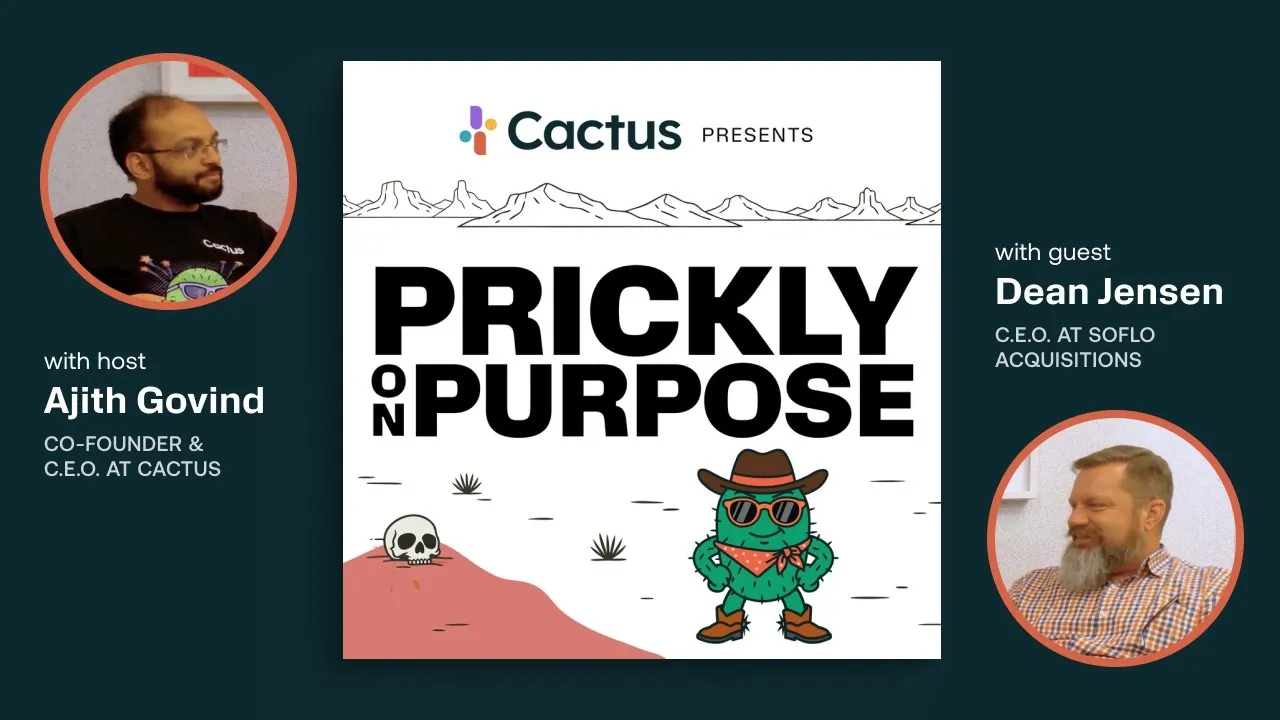
What happens to a home service company after private equity buys it, and what other options do owners have when they're ready to sell? In episode 4 of Prickly on Purpose, Cactus co-founder and CEO AJ talks with Dean Jensen, founder and CEO of SoFlo Acquisitions, a purpose-driven firm that plans to acquire HVAC businesses in Central and South Florida.
In this episode
- How the closing of Joann Fabrics led Dean to start SoFlo Acquisitions
- How SoFlo plans to differ from Wall Street private equity after an acquisition, including a path for employees to eventually buy out investors
- What owners thinking about an exit should weigh beyond the sale price
- How SoFlo plans to tie employee pay and personal development to company growth
- Why Dean thinks private equity roll-ups will fragment the trades rather than consolidate them
- Why he believes everything is sales, and what he'd tell owners stuck at $2 to $3 million
Chapters
The write-up
In this episode of Prickly on Purpose, Cactus co-founder and CEO Ajith sits down with Dean Jensen, founder and CEO of SoFlo Acquisitions, a purpose-driven investment firm buying up home service businesses in Florida.
It started with a fabric store closing
Dean didn’t set out to start an investment firm. In 2025, he went with his wife to a Joann Fabrics store to buy craft supplies and found out the chain was shutting down, nationwide. That struck him as odd for a company that had been around forever, so he dug into what happened. The more he learned, the worse it got.
Joann had been acquired by private equity about 13 or 14 years earlier. What Dean calls “Wall Street private equity” did what it does: it ran the company into bankruptcy in 2020, brought it out supposedly reformed, and by 2025 it was bankrupt again. The company disappeared. Only the name survived, and Michaels bought that.
“My first thought was, I can’t believe that not only is this legal to do in the US, but companies do it on purpose,” Dean says. “And I thought, someone has got to do something about this. And my very next thought was, well, I’m an entrepreneur, why don’t I do something about it?”
That was the birth of SoFlo Acquisitions. Dean had an extensive background in the trades, HVAC specifically, and he lived in South Florida, where HVAC runs year round. The pieces came together, and SoFlo went looking for Main Street businesses it could buy and actually keep alive.
The acquisition model is the same. Everything after it isn’t.
Ajith asks the obvious question: is this an anti-private-equity model? Dean’s answer is more precise than that.
“We do use the private equity model for the acquisition. They have a great model for acquisitions,” he says. “It’s what happens after the acquisition that sets us apart.”
He describes one of the standard moves: private equity firms often strip assets out of a company after buying it, then force the company to lease those same assets back. That creates an expense that never existed before and never needed to, on top of other financial engineering, and it’s a big part of how these firms drive companies into the ground.
SoFlo is structured differently by design. It isn’t a fund charging a management fee. It’s a holding company, so instead of fees flowing to a manager, profits flow directly to the company and its investors. Dean sums up the mission plainly: rescue Main Street jobs from Wall Street private equity.
An exit that turns into a retirement plan
The other place SoFlo departs from the standard model is the exit. Most private equity wants out in five to seven years. SoFlo’s planned exit is for employees to eventually purchase the investors’ equity, turning ownership into a retirement plan for the people who actually run the business.
That structure changes incentives all the way down. Because SoFlo isn’t pulling profit out through fees, it can pay employees better, and it pairs their compensation with the company’s growth so they have a direct stake in its success.
Dean treats development as part of that same bet. “The skill sets that get you to a million or five million dollars a year in revenue are not the skill sets that are going to get you to twenty,” he says. Helping employees build those skills isn’t a perk bolted onto the business model. It’s the business model: the company grows, the people inside it get more valuable, and both get paid accordingly.
Which owners SoFlo is built for
Dean sees roughly two kinds of owners in HVAC, plumbing, and roofing. One wants to keep the business in the family and take it from five million to ten million to a hundred million. The other is looking for an exit in three to five years and assumes private equity is the only buyer with real money.
SoFlo pays competitive, market-rate prices either way, so price isn’t the differentiator. The differentiator is what happens to what the owner actually built. “Most of them have invested a lot of their blood, sweat, and tears,” Dean says. For an owner near retirement, or one who’s grown the business as far as their current skill set allows, the fear isn’t really about the sale price. It’s about watching a company they spent their life building disappear two or five years later.
Dean is direct about what that legacy actually is. “For most of these owners, the legacy is not their customers. The legacy is their employees.” When private equity buys a trade business, he argues, the workers leave, because the culture shifts from taking care of the customer to squeezing out an extra dollar. Keeping the people is what keeps the legacy intact, not keeping the name on the door.
Why Dean doesn’t think private equity will win
Ajith raises a theory that circulates in tech and investing circles: that private equity will eventually roll up 70 or 80 percent of the home services market, leaving four or five dominant players. Dean doesn’t buy it.
His reasoning comes down to a structural feature of the trades that most roll-up strategies overlook. Technicians in HVAC, plumbing, and similar fields hold individual licenses. Whenever they want, they can hang up their own shingle and start a competing business, and the cost to do that is low. “It’s what we call a very fractured industry,” Dean says.
Combine that with the attrition private equity roll-ups tend to cause, workers who feel like a number instead of someone whose boss knows their family, and you get an industry that keeps regenerating small, independent competitors even as consolidation happens. “In many ways, private equity is actually fragmenting the market more,” Dean says. Those departures don’t just work against consolidation in the abstract. They become a steady pipeline of future acquisition targets for a firm like SoFlo, five, ten, fifteen years out.
Two pieces of advice for owners hitting the ceiling
Asked what he’d tell an owner stuck around two or three million in revenue, struggling to make payroll, Dean doesn’t hesitate. First: if you’re struggling to meet payroll, raise your prices. It usually means you have good people and good service you’re underpricing. You won’t lose customers, he says, you’ll get better ones.
Second: once there’s some breathing room, bring in outside help. “There is no founder that can do it all,” Dean says. “Business is not a solo thing. Business is a team sport.”
Where this is going
SoFlo’s near-term plan is concrete: $36 million in acquisitions over the next 12 to 18 months, funded by a $6 million capital raise that already has more than a million dollars committed. The first acquisition is expected to close by the end of this quarter. The team behind it includes a director of finance who helped take a commercial landscaping business from $6 million to roughly $250 million in revenue before it exited to private equity, and a director of operations who’s a two-time HVAC exit owner himself.
The initial focus is Central and South Florida, a market Dean sizes at $6.5 billion once you combine the Tampa/Orlando, Southwest Florida, and South Florida regions, likely a top-five HVAC market in the country. From there, the plan is to expand into other trades, electrical and plumbing beyond HVAC, and eventually other geographies. Dean’s long-term vision is a multi-billion-dollar company built around one idea: long-term, sustainable jobs in the skilled trades, run by people who never have to watch their legacy get sold off in pieces.
These are Dean's views from the conversation, not investment advice or an offer to invest.
Transcript (lightly edited)
Speech-to-text of the published episode, lightly edited for reading: we removed short "yeah" and "right" interjections said over the other speaker and checked the names. Speakers: Ajith Govind (host) and Dean Jensen. Tap a time to play from there.
Read the full transcript5,269 words · 30 min
- 0:00 Dean
Can't believe that not only is this legal to do in the US, but the companies do it on purpose, like private equity does it on purpose. And I thought, "Someone has got to do something about this." And my very next thought was, "Well, I'm an entrepreneur. Why don't I do something about it?" And that was the birth of SoFlo Acquisitions.
- 0:30 Ajith
Welcome back to Prickly on Purpose podcast. My name is AJ. I'm the co-founder and CEO of Cactus. I have with me today one of the most interesting people that we have ever met. His name is Dean Jensen. He is the founder and CEO of SoFlo Acquisitions. And I'll let you say this, uh, this is a purpose-driven investment firm. And thank you so much for having, uh, you know, having y- we are, we are so excited to have you here, and I wanna get right into this, right?
- 1:04 Dean
Oh, sure.
- 1:06 Ajith
What is different between SoFlo and a private equity?
- 1:11 Dean
Good question. Well, first, thank you for having me. I'm really excited to be here today. So, um, the biggest difference between SoFlo Acquisitions and traditional private equity is that SoFlo Acquisitions is focused on long-term sustainability and long-term opportunities for its employees, for the people who work for the companies that we acquire. Uh, we're not just there to make a buck which is what most private equity companies are there for. They just wanna make a buck and move on to the next deal. We're there to build a long-term sustainable business.
- 1:42 Ajith
And how did you come to this model? T- walk us through your journey, uh, in trades and your background, and how did you get to this model?
- 1:52 Dean
Sure. So the SoFlo journey started, um, in 2025. My... I went with my wife to JOANN Fabric to buy some fabric for a craft she was working on, and we found out that JOANN was closing and, like, across the country. And I thought that was really odd, because it's such a big company, and they've been around forever. I was curious what happened that kind of drove it to that direction. And the more I dug, the more I just felt this big pit in my stomach. They were acquired by private equity about, uh, 13 or 14 years earlier. Um, the private equity did what private equity does.
- 2:33
I call it Wall Street private equity. Obviously, smaller in private equity is different, but um, they effectively just bled the company dry. Ran it into bankruptcy in 2020. They came out of bankruptcy, supposedly reformed, and by 2025, they were in bankruptcy again, and the company disappeared. The only thing left is its name, and that Michaels bought that. And my first thought was, "I can't believe that not only is this legal to do in the US, but the companies do it on purpose, like private equity does it on purpose." And I thought, "Someone has got to do something about this." And my very next thought was, "Well, I'm an entrepreneur.
- 3:14
Why don't I do something about it?" And that was the birth of SoFlo Acquisitions. Um, in trying to find an industry to bring this philosophy to bear, where we could come in and take over companies with all of the, you know, baby boomers retiring, someone needs to take over these businesses um, to rescue these jobs for all of these Main Street workers. Um, I have a, an extensive background in the, in the trades, uh, s- in, in HVAC specifically. And so since we live in South Florida, in the Florida Keys um, it was a perfect fit. HVAC is a year-round thing there. So really just a lot of things came together at all at the same time to be able to make this a reality.
- 3:57 Ajith
That's awesome. So is it fair to say that this is an anti-private equity, uh, model?
- 4:07 Dean
I-
- 4:07 Ajith
How do you think of that?
- 4:08 Dean
Don't know. I... So here's the way I think about it. I, I think private equity, there's a l- there, it's a pretty broad field, because there are a lot of different players in the private equity space. Um, I do... We, we do use the private equity model for the acquisition. So coming in to acquire it, and they have a great model for acquisitions. It's what happens after the acquisition that sets us apart. Um, so I, our core mission at SoFlo Acquisitions is to rescue Main Street jobs from Wall Street private equity. That's our core mission, and in that way, we are very different than private equity. So you could say we're anti-Wall Street private equity, for sure.
- 4:51 Ajith
And how do you make sure that the Main Street jobs remain Main Street? How do you make sure of that? What is the difference between what private equity does and what you do?
- 5:01 Dean
So one of the things that private equity does after they acquire a company is they will take assets out of the company and force the company to lease those assets back to the company. And so you're taking m- or creating an expense in the business that was never there before and never needed to be there. Um, and that's what... Between doing that and some other financial games they play, they really drive these companies into the ground. And we keep all of that in-house. We're not charging a huge management fee to manage the company. We're structured very different, um, that we are not a fund.
- 5:40
We're an actual company that is acquiring these other companies, so we're a holding company. Um, so instead of charging a management fee, the profits just flow directly to the holding company for our investors. The other key part of this long-term is with most private equity type investors, they wanna have some kind of an exit in the five to seven-year window. And so the exit we have planned for that is to actually have the employees purchase the as- investor's portion of the equity in SoFlo Acquisitions as a retirement plan for the employees. So it really creates a long-term buy-in from the employees, which allows us to pay them better because we're not taking profits out of the company the way a lot of private, large private equity does.
- 6:32
And we have a long-term vision for them to buy into the company because the better the company does, the better their retirement is going to be.
- 6:38 Ajith
Right. Now, we work with a lot of business owners HVAC, plumbing, roofing companies. Uh, we come across broadly, like two types of owners. There's one kind of an owner who will say, "I'm a family-owned business. I never want to sell," right? "I want to take this to, like, 5 million, 10 million, and eventually 1- 100 million." And then there's the other kind of the owner, right? Who says, "I'm, I'm looking for an exit in, like, three years or, like-" "five years, and I want private equity to buy, buy me out," right? What are your, uh... Which kind of founders or business owners do you want to work with? And why is- why would you tell them that you're better than private equity, especially when private equity can give them, like, I think, better multiples maybe?
- 7:28 Dean
No. We, we pay a competitive price for, for the companies. So we're right in line with market prices. The biggest advantage that we have is with these, um, with these home service business owners most of them have invested a lot of their blood, sweat, and tears building this either from nothing or from wherever they happen to acquire it up to wherever it is today. And if they're looking for an exit, um, it's either retirement or they have grown to a point where they don't have the skill set to grow beyond that. If it's someone who wants to scale their business, they probably have the same, uh, philosophy in terms of what their goals are after they're done with the company, right?
- 8:15
They wanna make sure that the company that they have spent their life building, their legacy, does not just all of a sudden disappear two years from now or five years from now. And that's the com- key component that we bring in, that, um, we are able to give them a competitive price for their, for their business while at the same time helping them really buy into the long-term vision of not only holding onto their legacy, but turning their legacy into something even greater and more beautiful than they have the skill set or time to do.
- 8:47 Ajith
Right. And it also makes sure that the employees who are, who are everything-
- 8:53 Dean
Well, that is their legacy. Right? The- For most of these owners, the legacy is not their customers. The legacy is their employees. And that's at the heart of every service company are the people that you have. And, and I believe that about all business. All business is about your people, and when you invest in your people, you get just extraordinary people and extraordinary work and an extraordinary business. And that's what these owners don't want to disappear. Uh, because when private equity comes in and buys a company, those workers all leave because because the culture changes and it is no longer about um, you know, do we take care of the customer and do an excellent job of what we do? It's now about how do we make an extra dollar?
- 9:38 Ajith
Yeah. That, uh, we heard that story from Ryan who was earlier on the podcast, and from a lot of business owners who've been through that. Uh, ironically, it also seems like private equity is kind of helping you by doing all of this. And you are truly a better option, not just for the business owner, but also for the company by itself, right? You are, uh... That's, that's really great to, uh, understand. Um, going a little bit deeper into this, right? Like, what do you do once you have the acquisition, right? How do you make sure that the company is growing? What does your team look like? Um, and what is your, you know, timeline for, uh, you know, growth and, you know, be- making the company better?
- 10:24 Dean
Yeah. So our timeline for growth, we'll start kind of there, and then we'll kind of take a little bit deeper dive on the other side of it. So we are planning to do $36 million in acquisitions over the next 12 to 18 months. Um we're doing a $6 million capital raise to accomplish that. Uh, we already have, um, over a million dollars committed already.
- 10:47 Ajith
Congratulations.
- 10:47 Dean
Yes. It, it, it's a lot of work-
- 10:49 Ajith
It is
- 10:49 Dean
As you know. It's raising capital is a lot of, a lot of meetings and a lot of work, and-
- 10:54 Ajith
It is
- 10:54 Dean
Selling a vision that's not the same as every other person that they typically invest in, so.
- 10:59 Ajith
Absolutely it is.
- 11:00 Dean
Um, and I will say, like, we fit in the weird, um, space. Um, and not to detract from what you guys have done, 'cause you guys have done amazing. Raising capital is hard, and you guys are pure venture capital. Like, that's you're, you're squarely in the venture capital space. We are in this weird space in between private equity and... 'Cause we're, well, we're not really private equity and we're not really venture capital but we're a startup like venture capital. And so it's a lot of conversations and helping investors see outside of the box to buy into a longer-term vision on, um, really being responsible with society with their investments. Um, so that's kind of our timeline. We expect to have our first acquisition, uh, completed by the end of the third quarter this year.
- 11:50 Ajith
Awesome. That's, that's-
- 11:51 Dean
So we're looking forward to that
- 11:52 Ajith
Truly amazing.
- 11:54 Dean
Yeah. So once we complete the acquisition, we have three core players in, on our team. Um, we have, um, a director of finance, uh, who he has ta- worked with a commercial landscaping business to take them from 6 million a year in revenue to almost, like, 249, so we'll call it 250 million a year in revenue. They exited to private equity. And, uh, so he is super excited about being part of this project because it's much more of a long-term thing versus just, again, selling right out to private equity and losing everything you spent all your time building. Um, our director of operations is a two-time exit, uh, HVAC owner that has sold one to private equity and one to another s- uh, small business owner, um, who is local to Florida.
- 12:46
Um, and so he is really, really excited to bring... It, it's a nice combination of down-to-earth, normal business owner type of mentality into something that's a much larger scale. And so, uh, it's a really solid team that we have in place. And then my background is I have background in the HVAC space, but in a lot of sales and marketing and business development side of things, and in establishing systems in organizations and growth. And so bringing all of these skill sets to bear on these companies that have been started from the ground up that, that don't have that kind of talent really brings things that the f- makes the future a lot brighter for these companies.
- 13:28
Um, one of the specific things that we do is once we complete an acquisition, we come in and work with the key employees, and we align their, their, their two parts of what I call compensation. So there's the actual amount that you pay them. So we align the cash that we pay them with the growth in the company so that as the company grows, they earn more. So that they have buy-in to the future success of the company. Um, but also, uh, personal development is really important to, to me and to us as an, an organization. Um, the skill sets that get you to a million or $5 million a year in revenue are not the skill sets that are gonna get you to 20.
- 14:12
And helping them develop personally to learn these skill sets and to learn how to lead organizations and make that transition is also a key part of what we do. So we're making them more valuable in the marketplace at the same time that we're paying them more.
- 14:27 Ajith
That's, uh... I think if I was an employee in one of these companies, I would be extremely excited about that because we are growing from 5 million to, like, 20 million. But yes, that's awesome, but I get to learn, and I get to grow and I see that journey, and that's, that's truly exciting, uh, as being, being part of that company. So that's truly amazing. Um, you mentioned about Florida. Now, you're not from Florida originally.
- 14:55 Dean
I'm not.
- 14:56 Ajith
Tell us about where you're from. And there's, there's, uh... And I'll just say this, Dean is a huge sailor.
- 15:05 Dean
I am.
- 15:06 Ajith
And it's one of those things which truly fascinates us. Uh, tell us a little bit about, you know, where you come from, how you got into sailing, how central it is to your life. We'd love to hear that.
- 15:19 Dean
So I was born and raised in the San Francisco Bay Area in Fremont. Um, I, it... So my childhood and growing up was this weird dual reality, okay? So we were raised at home, same as any other, you know, working class, middle class family. Right? You know, we were on a strict budget with how school clothes. You know, we didn't eat out a lot. We didn't have fancy things at home. But my father was a dentist, and he did really, really well as a dentist. Um, and he got into sailing, um, about 10 years before I was born. And, uh, so by the time I was nine years old, he had a 48-foot sailboat custom designed and built for him that I grew up racing on San Francisco Bay.
- 16:11 Ajith
That's awesome.
- 16:12 Dean
So when I say it was like this weird dichotomy, at home my mother would say things like, "Well, I'm not sure if we can afford, uh, $50 for a pair of pants." You know, because that's designer jeans, let's go get the $10 one from Gemco, which is dating me. Which became Target, okay? Back in the day.
- 16:36 Ajith
I don't know that, but yeah.
- 16:37 Dean
So yeah. You're much younger than I am. Um, so that's what I would hear from my mother, and my father would always be careful about what was spent at home and, and day-to-day life. But then we would go up to the boat, and we would stop at West Marine products and look at a piece of electronics, and it would be, like, a $5,000 piece of electronics he would just see, and he'd go, "That looks like that'd be good for the boat. Let me just buy that." And he'd write a check for it.
- 17:03 Ajith
Oh, this is awesome.
- 17:05 Dean
It, it was just weird, you know? And as a child growing up in that, you don't really appreciate what all of that means until you become an adult and you realize what it actually took to be able to do that in the early 1980s. So-
- 17:19 Ajith
I think it also, like, shows discipline at home and a way of life versus, okay, this is our work mode, and this is our, like, party mode like, our play mode. So-
- 17:31 Dean
Yeah. So I grew up sailing that on San Francisco Bay. Um, I have done a lot of racing on the bay. Um, I have done, sailed as far south as Manzanillo, Mexico, all the way up to the north end of Vancouver Island in Canada. And I've done the race from the West Coast to Hawaii twice.
- 17:49 Ajith
That's amazing.
- 17:50 Dean
So a lot of sailing.
- 17:51 Ajith
That is so cool.
- 17:52 Dean
And I currently own a 30-foot racing sailboat, so.
- 17:54 Ajith
Wow, I didn't know that. That's, that's, that's really cool. And how often are you on the water and-
- 17:59 Dean
Lately, not much. So we were in Houston for 11 years, and that's where I bought my boat. I bought it from, uh, someone in California and took it out to Houston. We did a lot of sailing and racing there. Um, and then four and a half years ago, we sold our house. I put the boat in storage, and we spent, uh, three years traveling the country in an RV. And, uh- We went down to the Florida Keys about a year and a half ago to check it out, and we just haven't left. So we just love the Florida Keys, and it's a beautiful place. The only thing that is not good for me is that my boat needs eight feet of water, and none of the channels are deep enough for my boat to fit.
- 18:40
They only go six feet deep, so I can't bring my boat to the Keys. I'd have to keep it in Miami. And so we're thinking about pro- possibly doing that, but we just haven't done it yet, so. 'Cause it's a long drive up.
- 18:51 Ajith
Yeah, it is. It is.
- 18:52 Dean
But so that's what brought us to Florida. And, uh, once we decided to stay in the Keys, um, uh, my work at the time was all remote. And, um, but it doesn't take a lot of my time, and I needed something bigger to do. Was kind of wondering what that next step would be, and that's when we walked into a Giant Fabrics in Miami and found out all of that, and SoFlo Acquisitions was born.
- 19:15 Ajith
Yeah. That's amazing. And back to SoFlo. Are you targeting acquisitions only in Florida? Is it outside Florida? How, how do you think about the strategy?
- 19:25 Dean
So our initial strategy for SoFlo is to target Central and South Florida. It's a huge market. It's a $6.5 billion market. Um, about two to three years down the road, once we get our acquisitions again stabilized and moving in the right direction, we will start taking this same business model to other markets and also to other trades. So beyond just HVAC, we'll move into um, into electrical, into plumbing. Um, but really skilled trades is where really what our core mission is about.
- 19:56 Ajith
And why did you choose HVAC to start with? Like, HVAC is so hot right now, right?
- 20:02 Dean
Uh, well, because it's so hot, that's one of the reasons. Right. Um, the ... Specifically in Central and South Florida, um, most HVAC companies are extremely seasonal. So they do probably 70 or 80% of their business in the summer months. And then in the winter is, the rest of the year, probably the other eight months of the year, is about 20% of their business. In Central and South Florida, HVAC is year-round. So even if it's in the middle of January, if your air conditioning system goes out, you're not gonna wait until May to get it fixed. It's gonna-
- 20:38 Ajith
So the seasonality is not there in Florida as much-
- 20:41 Dean
As, not near as much, yeah. We will do probably 60 to 65% of our business across the sum- summer months and the other 35 to 40% over the, the rest of the year.
- 20:51 Ajith
Is it the largest market for HVAC, uh, in the country, uh?
- 20:55 Dean
Um, it is one of the largest. I don't think it's the largest. LA I think is the largest market, LA and San Diego. Um, Phoenix and Miam- and Central and South Florida. So they, they treat markets differently. The, our area, our market size where we are targeting is actually includes, in Florida, three different markets. So there's the Tampa and Orlando area, there's Southwest Florida, and then South Florida. And so they're, they're really three different markets. So if you combine all of those, we're probably in, in the top five for sure.
- 21:29 Ajith
Okay. Got it. What is the long-term vision for SoFlo? Let's say we are 5, 10 years from now, what does SoFlo look like? What would you love for it to be look?
- 21:41 Dean
So the long term, really, I- I see more than, like, 5 years down the road is one place, 10 to 15, and 20 years down the road. Really what I envision is this company that helps long term, create long-term su- sustainability with the trade, with trade businesses. Uh, we're not looking to come in and rebrand and take over and rename the company and turn it into something it's not. We, we wanna keep these very focused on the employees, very focused on high-quality customer experience. Um, but it's something, a model that we've taken to other areas in the country and other trades. Um, and I really think that we can become a multi-billion dollar company, um, that is really focused on maintaining long-term skilled trades jobs.
- 22:29 Ajith
Amazing. I love that vision. There's this talk in the tech world, right that private equity is, uh... Of course, we are an AI company. We work in the trades. Uh, there's this talk that private equity is going to roll up, like 70% or 80% of the market. There's going to be, like, four or five players. Do you believe that's gonna happen based on what's, uh, you know, what's happening so far? Uh-
- 22:59 Dean
In-
- 22:59 Ajith
Do you see that work?
- 23:00 Dean
In the home services sector is that what you're asking? No, I don't think that's gonna happen at all, and here's why. As these Wall Street private equity firms consolidate and do the roll-ups and all of that, the thing that happens is there's a lot of attrition. So these workers are there. They wind up being put, instead of having a, a boss that is looking out for them and knows their family and is really, you know, the company is interested in helping them progress they just become a number, and they're moving through, uh, regular pay raises, you know. And there's, it, it's all systemized
- 23:39
Which is good, but it also is so structured that it doesn't leave a lot of individuality in there. And so what ends up happening is a lot of these guys will, some of them leave to go work for other companies that are not private equity owned. But one of the other interesting facts about the home services business, whether it's HVAC or plumbing or anything like that, these guys hold an individual license. And so whenever they want to, they can just go out and hang up their own shingle and start their own business. Um, it's what we call a very fractured industry because the barriers to entry, the cost to actually start your own business doing it is
- 24:19
Relatively low. And so that's actually what ends up happening, so which bodes well for us because our acquisition model, we're very competitive when we come in because we can pay a competitive price, but we're a much, much better option for the, for sellers for maintaining their legacy and being focused on their employees. But at the same time, all these private equity companies that are doing these roll-ups, they're losing people. Like, the attrition in there is phenomenal. And they're going out and starting new businesses, which means we have a steady flow of new acquisitions in five, 10 15 years down the road.
- 24:58 Ajith
So in many ways, private equity is actually fragmenting the market more. Okay. That's, uh, that's, that's very interesting. That's very intriguing. Um, I wanna shift gears. Um, apart from, of course, your trades background and everything, you're one of the most inspirational sales, uh leaders that I have met. Uh, and it's been great to work with you. Uh, can you talk us a little, uh, through about your sales journey, how you got here, and what, what is your philosophy in sales? Um-
- 25:38 Dean
So, gosh, my sales journey. Um, I, I have never, to this day, had a job where I was paid only a salary. There has always been a performance component of my income. Uh, my very first job in high school, I got a... You know, I didn't wanna work at a McDonald's or fast food, so I went down to the mall and applied at a men's clothing store. And I was selling suits to businessmen as a teenager in high school.
- 26:10 Ajith
Beautiful.
- 26:10 Dean
And so, um, that, that was my first step into sales. Um, and from there, s- small business ownership. Um, when we left Seattle and moved to Houston, um, we really just kind of reset everything in our lives, and I, uh, got a job selling life insurance for an insurance company. Um, I built a team of insurance agents from just me to doing $2.5 million a year in sales in about 14 months. Um, and so for me, s- everything is sales, right? Everything we do is always sales. Doesn't matter what your role is. You have to sell your manager on why to keep you. All of it is always sales.
- 26:55
And at the end of the day, sales is not pushing something on somebody. It's understanding what the customer is experiencing and what they... And then helping being an expert and a consultant with them to help them improve what they've got. And then hopefully your tools that you are trying to sell fit into that model. Um, but really it starts with the customer and ends with the customer. Um, and then what we sell, it just happens to be a byproduct of that that, and that's how the income's generated. And that- that's how I view sales, and it's how I teach sales. And, um, I believe the results have spoken for themselves.
- 27:33 Ajith
Oh, yeah. Absolutely. And I think, uh, s- highly resonates with me, uh, personally, and I love that it's, it's more about finding the right fit versus trying to push something across. And especially the consultative side of things. I love that. That's, that's beautiful. Uh, well, I'm going to end the podcast with couple of questions.
- 27:56 Dean
Rapid fire, huh?
- 27:56 Ajith
Rapid fire.
- 27:57 Dean
All right. Let's go.
- 27:58 Ajith
Yes. The first thing is, what would you tell a business owner who is hitting the ceiling, right? Who is like two million, three million, they've been struggling. They're in their trucks the whole day, and they're struggling to hit payroll. We know a lot of them. What would you tell them, and how would you, uh... Yeah, that's the first question.
- 28:22 Dean
Well, I think... So I'm gonna answer it with two things. Number one, if the problem is they're struggling to meet payroll, they need to meet their prices, raise their prices. Because it means that they have got a good service, and they've got good people working for them. They just can't afford to pay them. They just need to raise prices. They're not gonna lose customers. They're just gonna get better customers. Uh, the second thing is, what I would tell them, is once they're profitable and not, maybe not s- not struggling, but, you know have a little bit of cash flow, they really, really need to bring in outside help, outside experts who know what they're doing. Um, because there is no founder that can do it all. Business is not a solo thing. Business is a team sport.
- 29:05 Ajith
Right. I love that. That's, that's beautiful. That's beautifully put. Final question. We know you love trivia. I've heard a lot of trivia from you. I want, I wanna hear your favorite trivia. Let's leave our viewers with one trivia.
- 29:22 Dean
Favorite trivia. Oh, my gosh. I don't know. Um, like, so my brain is like, there- there's a Jimmy Buffett song. It's called Useless But Important Information. That, that's my brain. So I don't know if I have a favorite trivia. Um-
- 29:37 Ajith
Yeah. You can pick more than one. That's fine.
- 29:39 Dean
Sure. So tallest mountain in the world from base to the, to peak, uh, most people tell you Mount Everest. It's actually Mauna Kea in Hawaii. It's just that most of it is underwater. So-
- 29:51 Ajith
And what is 30,000 feet underwater, do you think?
- 29:53 Dean
Uh, just about 30, yeah, 25 or 30,000 feet down is where it starts. So it's very, very deep out there. Um, and I've been swimming out in the middle of the Pacific Ocean with 30,000 feet of water underneath me. So it's a lot of fun.
- 30:05 Ajith
That, that is impressive. Not many people can say that.
- 30:07 Dean
Not many people. So a lot of fun. Um, yeah. Yeah, I would say that I just... But I do think it helps me with sales, though. Having such a broad background and a lot of interesting facts floating-
- 30:19 Ajith
It does
- 30:19 Dean
Around mindlessly in my head help me connect with a lot of people really easily.
- 30:23 Ajith
Yes. Connection is important in sales.
- 30:25 Dean
So, yes.
- 30:26 Ajith
Absolutely. Fantastic. With that, uh, thank you so much for being on the podcast, Dean.
- 30:31 Dean
Thank you, AJ. I appreciate it. It's been great being here.
- 30:33 Ajith
It's been a pleasure working with you, and we look forward to working with you for a long time.
- 30:37 Dean
Absolutely. Thank you.