Prickly on Purpose · Ep. 3 · 29 min
Hiring Is a Timing Problem: Wendy Moore on Building the Right Team
Published on YouTube
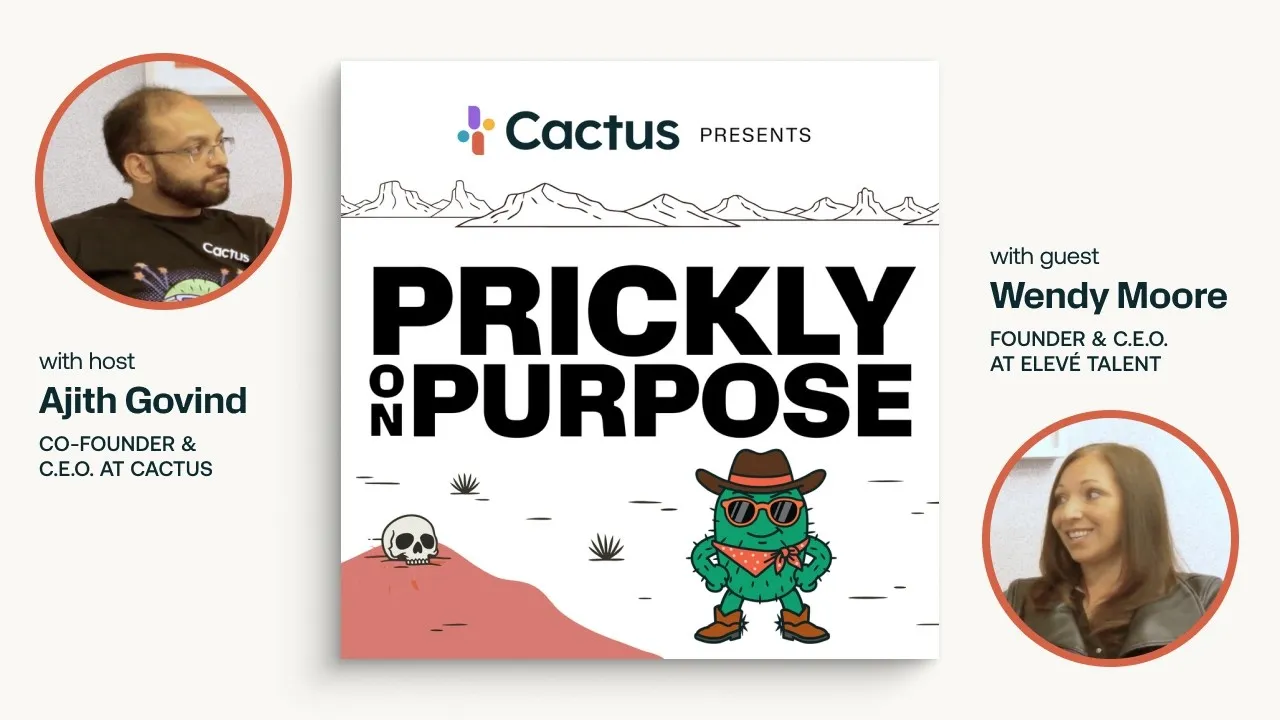
When should a startup hire its first salesperson, chief of staff or forward deployed engineer? In this episode of Prickly on Purpose, Cactus co-founder and CEO AJ talks with Wendy Moore, co-founder and CEO of Elevé Talent, about hiring the right people at the right time.
In this episode
- Why Wendy built Elevé around a scope-of-work model instead of contingency placement fees or hourly billing
- Why she sees sales hired too early and chiefs of staff hired too late
- How diverse perspectives help a team understand the customers it serves
- What she learned building a recruiting business outside the major tech hubs
- Why she plans the next five hires before writing a single job description
- How AI takes repetitive recruiting work off her team, and the noise it adds to hiring
Chapters
The write-up
In this episode of Prickly on Purpose, Cactus co-founder and CEO AJ talks with Wendy Moore, founder and CEO of Elevé Talent, about what actually breaks hiring at startups, and why almost none of it is about finding good people.
Wendy Moore is the co-founder and CEO of Elevé Talent, a TEDx speaker, a 20 Under 40 honoree, and the builder of a bootstrapped, referral-only recruiting firm out of Missouri, far outside the usual startup hubs.
Hiring is a timing problem, not a talent problem
Wendy’s founding belief is simple and a little uncomfortable: “You can have the best idea in the world, but if you don’t have the right people at the right time, it does not matter.” Most founders obsess over who to hire. Wendy spends just as much energy on when. Hire the best salesperson in the world before you’re ready for them, and they fail, not because they’re bad, but because the seat isn’t ready for them yet.
Why she won’t touch the traditional recruiting model
AJ brings up something founders rarely say out loud: contingent recruiting fees quietly reward the wrong outcomes. Higher salaries mean bigger fees. Turnover means another placement. “The motivations felt misaligned to me,” Wendy says. “I also never liked to have any foot in the camp when the offer is being negotiated. I want that offer to be for the best of the company and the candidate, not for me.”
Her model is scope-of-work, not contingent or hourly: closer to how a law firm operates than how a staffing agency does. Her team is expected to be strategic and do the unglamorous execution work most recruiters skip. And the actual measure of success isn’t the placement, it’s getting replaced. “Success looks like we replace ourselves,” she says. She’s currently helping two long-term clients hire an internal head of talent so she can hand off the relationship entirely. “I’m gonna pass the baton and wish them well.”
The two hires everyone gets backwards
Asked where timing goes wrong most, Wendy doesn’t hesitate: sales, too early, and ops, too late.
Founders hire a salesperson before founder-led sales is repeatable, “if that motion is not perfected… you’re too early to hire a salesperson,” or they overhire, bringing in a CRO-level person to do SDR work. On the other end, she sees the chief of staff role show up roughly six months later than it should have. Not an executive assistant, not an office manager: a strategic partner who takes the minutiae off a founder’s plate so they can stop working in the business and start working on it. “Once that person’s in place, you’re like, that’s what I can accomplish when I’m not managing this, this, this, and this.”
Build a team that looks like who you serve
Wendy’s TEDx talk centers on representation, and the logic she gives AJ is practical, not abstract: your team should reflect the people you’re building for. A company serving the trades needs voices at the table who understand that world. “Where I see teams stagnate is where everybody’s the same… you’re just gonna be in an echo chamber at that point.” She extends the same logic to geography, operating from Missouri rather than a coastal hub cost her some clients early on, but she’s since proven it’s an asset: sitting in the middle of the country, she serves both coasts without asking anyone to take a 6am call, and most of her team was hired and onboarded entirely virtually.
What she’d tell any founder about to make their next five hires
Wendy’s advice isn’t a hiring checklist. It’s a sequencing discipline. Plan your next five hires as a batch, and know what each one is meant to unlock before you write the job description. “Too often we get distracted by making a JD… that’s not the first step. The first step is thinking through your own strategy.” And skip the headcount vanity metric entirely. As she puts it, “this isn’t about hitting specific headcount numbers anymore. You have to run so lean for longer than ever before.” The mistake on the other side isn’t hiring too cautiously; it’s throwing people at a problem with no plan for what happens once they actually start.
She’s equally direct about AI: it’s freed her team from repetitive, tedious work so people can spend more time on judgment and relationships, not less. As she puts it, “AI has enabled us to keep more human in the loop than less.” The tradeoff is noise: more volume, more fraud, more tooling required just to manage the flood. Her ambition is to build an AI-native recruiting team for AI-native companies, at a scale where she never has to keep a client on a waitlist again.
Watch the full conversation for more on Wendy’s take on chief-of-staff timing, diverse team-building in practice, and what she calls the “revolution” recruiting still needs.
These are Wendy's views from the conversation.
Transcript (lightly edited)
Speech-to-text of the published episode, lightly edited for reading: we removed short "yeah" and "right" interjections said over the other speaker and checked the names. Speakers: Ajith Govind (host) and Wendy Moore. Tap a time to play from there.
Read the full transcript5,012 words · 29 min
- 0:00 Wendy
I believe very strongly that having diverse perspectives at the table are representative of who you're serving. And so your team should be representative of who you're serving and how and, and who you wanna be and how you wanna do that.
- 0:26 Ajith
Welcome back to Prickly on Purpose Podcast. My name is AJ. I'm the co-founder and CEO of Cactus. I have with me a very, very special guest today. She is Wendy Moore. She is the co-founder and CEO of Elevé Talent, and she's also a TEDx speaker. She was 20 Under 40 recognized as one of the entrepreneurs, and she is building intentional teams for companies and startups. Welcome to the podcast, Wendy.
- 0:56 Wendy
Thank you. Happy to be here.
- 0:58 Ajith
Thank you so much for being here. I'm going to get right into it and ask what is your philosophy on hiring, and why, why do you think so differently from every other recruiter that we have ever talked to?
- 1:16 Wendy
So I think why I founded Elevé to begin with is I feel very passionately that you can have the best idea in the world, but if you don't have the right people at the right time, it does not matter. That's the thing that I... My whole career in startups, that's the thing I kept seeing make or break teams, is just the right people in the right seats at the right time. And I think the timing is half the battle because a lot of people get fixated on who they hire and when, and that matters a lot. But if you hire the best salesperson in the world but you're not ready for them, they're, they're not gonna succeed, or if you just have them in the wrong seat. And so I'm just so passionate about getting that piece of the puzzle right, and it's all about just good humans building cool stuff at the end of the day.
- 2:05 Ajith
That's, that's amazing. So how do you know the timing is right, and how do you choose the companies that you work with? Because I know you don't work with everybody. You, you are overbooked. You have too much demand. You're extremely different from, like, the traditional recruiting companies who are, you know, doing outbound and, you know, I get, like, a ton of outreach from companies. You're, you're the exact polar opposite. How, how do you figure out which companies are the right companies for you?
- 2:35 Wendy
Yeah, that's a good question. I mean, a lot of it is very organic. I spend a lot of time in startup communities all over the country and the UK as well, and a big part of it is just a natural, like, attraction. Like, good founders know other good founders, and they refer their colleagues, their friends, um, founder cohorts. And so I really have never sold since starting Elevé four years ago. It's been a byproduct of the work I already was doing in the startup community and then great founders that I've worked with who are happy with what we do, and then they tell their friends about it.
- 3:09
So we've really been able to grow like that. Um, again, so much about the work that we do is community and connections. And so not pushing that out, but really it's an attraction, um, has, has been the best sales process of all time. Now, we do some, um, some outbound a little bit, but we choose, like I said, I'm j- I'm gonna say this probably 10 times during this talk, is good people building cool stuff. That is my theme. We work across every industry you can imagine, um, all sorts of solutions. The founders come from different backgrounds, but the through line is they care about the problem that they're solving, and they care about how they build it.
- 3:52
And the how they build it, how they treat their team in the process, that they're building quality, beautiful things and delivering that well, that's my filter for who we're willing to work with as clients. And you're a great example of that.
- 4:06 Ajith
Thank you. Thank you. How did you get so interested in, in hiring and HR? And talk to us a little bit about how you got here. You, you have a fantastic background. You worked as a COO in the previous company. Um, tell us how, how you got here.
- 4:25 Wendy
Yeah. I was always an operations finance side of the house, so HR is not a natural, um, transition necessarily from that. But really my through line of my career is I love solving problems, and I love how people in tech work together, and so that is a through line. I, you know, started out in operations. I started out in economic development actually, so it was my job to build entrepreneurial ecosystems. And so I was part of large corporations and how they grew, but then also grassroots startups. And so we did what I now know as talent attraction but wouldn't have called it that at the time.
- 5:02
You know, trying to solve tech talent problems in Charleston and then, um, trying to work with companies for what they needed to build their companies. But it was always from an operational lens. It was always from a growth lens. And then when I was in f- the financial seat, it was always we're forecasting out growth, we're forecasting out, um, you know, how do we get there? Well, it's people. So at the end of the day, the people are implementing that strategy, and so my through line was always how we build, how we grow. And so I moved into change management in a large corporate IT.
- 5:37
Again, people and tech. That was just always that theme, bringing people along with you as new tech rolls out, as new products roll out. And then I, I really got the startup bug though, and I moved out of the corporate space into startups, joined as employee four at a health tech startup. It was just starting out, and it was brand new and had just finished a c- a pre-seed and ultimately became the COO of that company. And sitting in that op seat- I had HR, I had, um, data protection, I had sales rolling up under me. I had really everything, and just really started getting fascinated by this early stage, what happens when you do get the right people in the right seats.
- 6:22
And that piece of the puzzle, we saw it go poorly, and we saw it go really well. And so I kept getting fascinated with solving for that. And as we were in that cohort, as we were raising, obviously you meet such great other founders. And so we were always sharing stories with other founders and other teams on what's working for you, what's not working for you. And when I decided to step out of that seat, which was very hard for me because when you're, you know, the second in command at a startup that you've built, you've built the team, it's y- it's part of you.
- 6:51
And I was like, something special has to be true if I'm gonna step away from this. And so I knew I wanted to start my own thing, and I wanted to solve a problem that was meaningful. And at the end of the day, I was like, what's meaningful is the people who are gonna build the next great things. I don't have to be the one who comes up with the idea of what's built. I wanna help enable that idea to come to life. And so that was ultimately what sparked Elevé and why I moved into this. And I was looking around, looking for a model that I liked.
- 7:25
And I w- I didn't see it. I didn't see something that I would've used as a COO. I didn't see my- myself as in any of the recruitment models that existed. And so that's, that's what got us to where we are.
- 7:39 Ajith
Let's, let's talk a little bit about your model which is I think one of the, the most fascinating things that, uh, you know, like me and Avinash have come across. Um, we, in my, at least in my previous startup, uh, we worked with I think potentially like 15 different recruiters. And, uh, you know, it, it ranged from like 5% like, uh, success fee all the way up to like, I think we have paid even like 40% success fee. And I've always felt that the incentives are so misaligned in that model because, you know, y- you want to, uh, you know, you want, you want higher salaries, and that's how you get paid higher. And you want people to leave as well because that's how you'll get paid higher because then you'll get... And so the... I felt the misaligns, and I would love to understand how you came about your model, what your model is, and how, how do you see that being implemented?
- 8:40 Wendy
Yeah. And so when I decided to scope this out, it was very much I took pieces of what does exist. You know, there's, um, I... What I knew I didn't wanna do is the contingent placement model. That was something that I did not feel I resonated with. The, the motivations felt misaligned to me. Felt very transactional. And to me, people are not transactional, and so that was very difficult. I also never liked to have, uh, any foot in the, in camp when the offer is being negotiated. I don't want that to be associated with my fee. I want that offer to be for the best of the company
- 9:17
And the cl- candidate, not for me. And so if I'm a neutral party, that just felt right for the way I wanted to work. But ultimately, I looked at professional services models and the way legal works and the way a lot of these companies already exist, and it's you have a great highly skilled kind of associate level person who's gonna, you know, add a lot of value and strategy, and then you have the execution of the, the deal and the execution of the work. And I liked that approach because there's the strategy, and then there's the execution in recruitment. And so you have to know what you're doing.
- 9:53
You have to know how to give counsel, when to push back on founders, when to, you know, kind of coach. But then you also just have to do the work, and there's a lot of honestly pretty tedious work in recruitment that just has to be done. And so I wanted to build a team that thought that way, that thought strategic but also doer. And so that's how we do our model, scope of work based. It's based on the lift essentially for our team. We don't do hourly billing. I wanted to avoid hourly billable hours. Um, so again, I, I just kind of custom built it around the scope of work approach for what recruitment should do.
- 10:29
And it should feel like I'm a part of your team. And that's the goal, is that we feel like an internal partner, part of the team for as long as you need us. And then honestly, success looks like we replace ourselves. I'm in the process of offloading two clients I've worked with for over a year. I'm hiring them an internal head of talent. I'm gonna pass the baton, and I'm gonna wish them well. And I'm always gonna be a part of having built that team, but I'm ultimately stepping away from it, and that's a great success story. That's they graduate, and they move on. And so that's...
- 11:03
It's not having that attachment as well is is helpful. Um, but we've helped build that team for ourselves.
- 11:09 Ajith
Yeah. And that's, that's beautiful. Pretty thing like where, thing where incentives are aligned and you're truly, you're su- being successful, but you're making sure the candidates are being successful and the company's also successful. It's a win-win-win for like everybody.
- 11:23 Wendy
Yeah. I like to think so.
- 11:24 Ajith
That is, that is beautiful, and I hope that, uh, you know, this is the start of a revolution in, in the, in the recruiting industry. This is, this is awesome, right? This is, this is what founders want. Um, I just wanna go back to some of the stories you said about the right timing and the team um, coming together at the right time. What, what is the cost of not doing that? And what's the cost of a mishire, right? And what is the cost of missing the timing? I, in you, you mentioned you've seen some places where it goes wrong. What do you... Like, how, what... Tell us about what you're seeing go, going wrong.
- 12:03 Wendy
Yeah. It's, it's probably too many stories to share in, in a one session- I think, you know, sales is a great example. I think sales is something that is, one, it's so case by case for the company. Um, I believe very strongly in founder-led sales first. If that is not perfected, if that motion is not perfected and you don't have a, a repeatable, scalable process you can hand off to a sales team you're too early to hire a salesperson. And so I see sales hired way too early, way too often. Or over-hired, so you're hiring like a CRO-level person who needs to really just be an SDR.
- 12:44
And so that is, I think, one of the themes I see the most is too early. Um, on the flip side, I see some roles hired way too late, right? Or just not enough, or not quite the right profile, and so it's the right idea but not the right profile. Um, and I'd say that's probably ops. I see like a chief of staff is now, I think, one of the most critical roles in a startup. And it's a great unlock for a founding team when hired well. And typically it's about six months later than it should be. You know? That, that's a pain point that I
- 13:19
See a lot, and it's not an executive assistant, it's not an, a, like an office manager. Like a true amazing strategic chief of staff can unlock so much for a founding team. And so that's when I see hired too late. And once that person's in place, you're like, "Oh, that's what I can accomplish when I'm not managing this, this, this, and this." And so those are the two very recurring ones. Um, I'm seeing a lot change in engineering right now. So engineering, like the board deployed engineer is kind of the hot new role, that bridge between engineering and sales, and that very technical, um, deployment team, and that looks as different as every company and product looks different.
- 14:03
And so a lot of it is just truly knowing the company, and that company and that clientele. Not just picking up something you saw on Reddit and copying that JD and making it your own. Like that's not the recipe for success. Because the other company down the street doesn't look like you and doesn't have the same set. And so it's, it's very nuanced but it's, that's what makes it fun.
- 14:28 Ajith
No, that's, that's really, uh... That's fascinating that you mentioned about like all these different roles, and I think one of the biggest, you know, unlocks that you have done for us is, uh, of course the execution is, is very important to like find the people, get the people, and get them through the door, and like make sure they're the right people. But I think there's a layer above that which you're, you're a true, like an advisor, uh, who's telling us how to kind of put these pieces together, build like an elite team which will all come together, whom to hire, whom not to c- hire at this point. I think that's a very big differentiator from like every other recruiting company that we have ever talked to. Um, that's, that's really amazing, and I was actually fascinated by the chief of staff quest- uh thing that you brought up, right? It's a highly debated role in today's-
- 15:23 Wendy
It is. Mm-hmm
- 15:23 Ajith
In today's world, and some founders think of it as, um, you know, uh, what, what is going on, like why, why, right? And then there are some founders who are like, "Yeah, this is awesome." So what exactly in your mind should a chief of staff be like executing in a company, and what is the unlock for a company? And what, what's the right time to hire the chief of staff?
- 15:46 Wendy
Yeah, I mean, very nuanced. I think, one, so much about all of these questions is who's already on your team. So typically, that's why I say it starts with the talent strategy, 'cause if you have a founding team that, again, you have a very balanced founding team and you've built out a lot of different departments already, so it's looking around and saying, "Who do I already have on the team and what are they covering? And then where are my gaps?" "And where am I as a founder spending more time than I should?" Because it's not the high value. And so that's where I think the, the chief of staff or that persona is an unlock for the founder specifically.
- 16:24
Because if you don't have somebody who's taking weight off of you as a founder, it means you as a founder are spending time on things that aren't high value, and you're getting distracted from the things that will move the needle more than anything. And it's hard to know. It's like working on the business versus in the business. If you're always working in the business on the minutiae, which is what a great like chief of staff or really strategic ops person can do you're not up here high level doing what you can. Now that looks different. There's great co-founding teams that balance that out and they don't really need that role.
- 17:02
But it's very specific on who you already have and how you as a founding team can operate.
- 17:10 Ajith
Yeah. That, that, there is a lot of nuance there. Um I was going through your TEDx talk.
- 17:15 Wendy
Oh, really?
- 17:16 Ajith
Yeah. And I highly recommend it to everybody by the way. And it's... I, I found one point there which was very interesting, which is about, you talked about representation in decision-making in companies and startups. Um, I just wanna go there, uh, for, for a minute. Why is that so central? Uh, and what do you think should happen from the very early days in a startup?
- 17:45 Wendy
Yeah. And that's, you know, the conversation around having a diverse team I think has had a lot of ebbs and flows in startup building. I believe very strongly that having diverse perspectives at the table are representative of who you're serving. And so your team should be representative of who you're serving and how all in and who you wanna be and how you wanna do that. And so if you, for example, you're serving the trades, which is an incredibly diverse, and SMBs, and you're- it's an incredibly diverse clientele that you're serving. You need to have voices in the room on your team that understand that and know, and even just from a diversity of thought, and perspective, and background, and, um, all of that adds such value and color to a team in the best way.
- 18:40
And where I see teams stagnate and where, is where everybody's the same. Everybody has the same background, same, you know, track, and you're just gonna be in an echo chamber at that point, and no new ideas. That's, that's not how innovation happens. Innovation happens because you challenge each other, and you hear something that you, surprised you or you didn't know before. And that can only come from diverse teams and diverse perspectives, in my opinion. And so it, it's a challenge. I won't sugarcoat that it is a challenge in recruiting in tech-
- 19:15 Ajith
It is
- 19:15 Wendy
To also build diverse teams, and intentionally. And so it's always a matter of just making sure you're getting that out in front of as many amazing people as you can who are qualified and exceptional, and giving everyone a shot to have that, that voice. And then being really intentional about how you choose. And how you welcome people into your team, and how you build that.
- 19:38 Ajith
I think that's, uh, it's, it's a very important point I feel in startups. Uh, and, you know, the- we get all of this advice that, yes, you're building a cult, right? And it's, yes, everybody sticks to some core principles and cult, but there's this misapprehens- of that, right? Where you say that everybody's the same, and, uh, then you don't think out- outside the box, and you don't see those voices, you don't hear those voices. So I think that's really cool. Um, you, you come from Missouri. And, uh, we should, we should touch on this. Um, you're not from the Valley, uh, you're not in New York. Uh, you're not in those, uh, the flashy startup uh, you know, circles, uh, on a daily-
- 20:24 Wendy
You mean the flyover states.
- 20:25 Ajith
Yes. You are. And you have built this business uh, four years, uh, bootstrapped without funding. Uh, with mostly through referrals. There are so many, I think, thousands or maybe millions of people wanting to do the same. What is your advice to them on building a business like this? And uh, how did you overcome this, um, you know, this perception or this... I think there is, there is this, uh, everybody has this, uh, gap, right? They're like, "Oh, I'm not in SF." Uh, "I- I'm not, uh, part of this business."
- 21:09 Wendy
There's definitely a little bit of a stigma to not be in one of the major tech hubs. And, you know, I've not won clients for exactly that reason. Um, or we've, you know, found people with, with roots in their city. So I have people on my team in New York City, people on my team in California, so. But at the beginning, yeah, that is absolutely a challenge. I think what we've been able to prove is that the geography does not matter. In fact, it's an asset in many ways. Because, one, sitting in the middle, I can serve both New York and California a lot easier
- 21:44
Than a lot of other teams who really don't wanna get up at 6:00 AM to have a have a call on the East Coast. Um, the teams we represent are very scattered and all over. But I do strongly believe that you can find really smart, exceptional people everywhere, and in many ways it's an asset. Again, it's all about who are you serving with your product. And so if your product is serving, you know, clients in the middle if it's serving, you know, clients internationally, then having, you know, voices on the team that are geographically diverse as well as, um, you know, other forms of diversity is really important.
- 22:24
Um, for me, I- it was building community. I think you can build community virtually as well as in person. I love in person, I prefer it. Um, I travel a lot because of that, so I can be in these hubs and I can be, you know, face to face with, with friends. But I will say most of my clients, I didn't meet in person before I started working with them. We met virtually, we were introduced virtually, and we work virtually together, and that has been an asset, honestly, more than a hindrance because it makes us available, and, um, able to work more agile than some.
- 22:59
So I'm not spending all my money on a nice shiny office. I'm doing it on great exceptional people. Right? Like and so it's all, it's all in the people, so.
- 23:08 Ajith
No, absolutely. Um, for startup founders, uh, right, who are in the, the seed stage, the Series A stage, maybe even Series B, Series C stage what would you... I- I know a lot of people want to work with you. Maybe you don't have the bandwidth to work with everybody. Uh, what would you-
- 23:26 Wendy
I'm graduating two clients, so I'm about to.
- 23:28 Ajith
You have a full time. Okay, that's great. That's awesome. Um, what would you say to them, the three things, right? Just top three things on how they should think about hiring and what not to do as well.
- 23:44 Wendy
Well, to me, the intentionality behind hiring is, is everything. So taking a second to plan out even your next five hires. I always think about it in just, you know, batches, and what are the next five hires going to unlock for you and why? And then back into the roles. I think too often we get distracted by making a JD and getting that out there in the world, and that's not the first step. The first step is thinking through your own strategy. And so that's not really three things, but, um taking that minute to pause and being intentional before you put somebody in that seat, who else can do some parts of that?
- 24:28
And making it unique to you and your team. This isn't about what everyone else is hiring. This isn't about hitting specific head count numbers anymore. You have to run so lean for longer now than ever before, and that's impressive. It's not about head count anymore, and that's the big shift we're seeing. The companies that succeed are thinking that way. So, and then what not to do is don't do the opposite of that. So don't just throw people at the problem and then think they're gonna sort it out. And have a plan for when people start. Know what they're gonna be working on, know how to set them up for success, and that is often missed.
- 25:06
You know, we get focused on, you know, the who and how. And then we don't think about what happens when they actually get on the team, so.
- 25:16 Ajith
That, that's beautiful. That's, that's really inspiring. Um, I wish we had this advice when we started the very first company all the way back. Um, it would have definitely helped a lot, for sure.
- 25:27 Wendy
Sometimes you have to learn the hard way, and so.
- 25:29 Ajith
Yeah. Sometimes you do. Um, final question, and I know we are an AI company. Uh, how do you think AI is changing the landscape for, of course for hiring but specifically for in software recruiting, right? Uh, I, I know you look, you use a lot of AI. Um, how do you do that? And how, where do you see this going, um, and what are your ambitions with AI, uh, in the future?
- 26:03 Wendy
Yeah. I mean, I'm, I'm very AI forward as a team, and the human in the loop is, is so critical. And I think in recruiting, it, it gets noisy. There's a lot of noise in this space. There's a lot being built in this space. We're building our own things. Um, but I will say that having the human element, AI has enabled us to keep more human in the loop than less. It's given us the ability to take some of the very tedious tasks that are very monotonous and just repetition and give that to a great agent. And then keep my team able to be the personal touch that is so necessary that you run out of time for.
- 26:49
And so it's, it's leverage. It's, it's allowed us to move faster and leaner. It allows the teams we build to move faster and leaner. The flip side of that is it creates a lot of noise. Right? So I mean, there's a lot of fraud, there's a lot of additional applications. There's just sheer volume has gone up incredibly. And so then you have to build AI tools to manage that. And so it's, there's pros and cons. Like any industry, I think recruiting has been hit quite heavily by that. Um, but I'm still very optimistic, and we have great ambitions as a team to become an incredibly AI forward, AI native recruiting team.
- 27:28
Because that's who we're building for. We're building for AI native companies. We're hiring this. We have to be as fluent as they are. And I'm most... I'm like 98% optimistic on it. And then my 2% is just we have to build smart. We have to build safely and compliantly, and just make sure that we're, you know, not adding to the noise.
- 27:51 Ajith
And do, do you see yourself, like, working with hundreds of customers at some point? Okay. That's, that's, that's exciting. That is exciting.
- 28:00 Wendy
Yeah. We, uh, we're building the team to do it, and we're building the tech to do it, and so we I don't wanna have a wait list anymore.
- 28:09 Ajith
That's awesome. Um, well, I want to leave with one thing which I really like you s- you mentioned. What is the one phrase that kind of sums up your purpose and life? Uh, and I want everybody to, uh, just understand that.
- 28:29 Wendy
I think bringing people together to build incredibly impactful things is my why and our purpose.
- 28:39 Ajith
Awesome. With that, we're, we're at the end of time, and thank you so much, Wendy, for being on the podcast. Uh, and we definitely look forward to working with you for a long time.
- 28:49 Wendy
It was my pleasure. Thank you.