Prickly on Purpose · Ep. 5 · 29 min
Turning Down Private Equity: Tony Alicea on Staying Family Owned
Published on YouTube
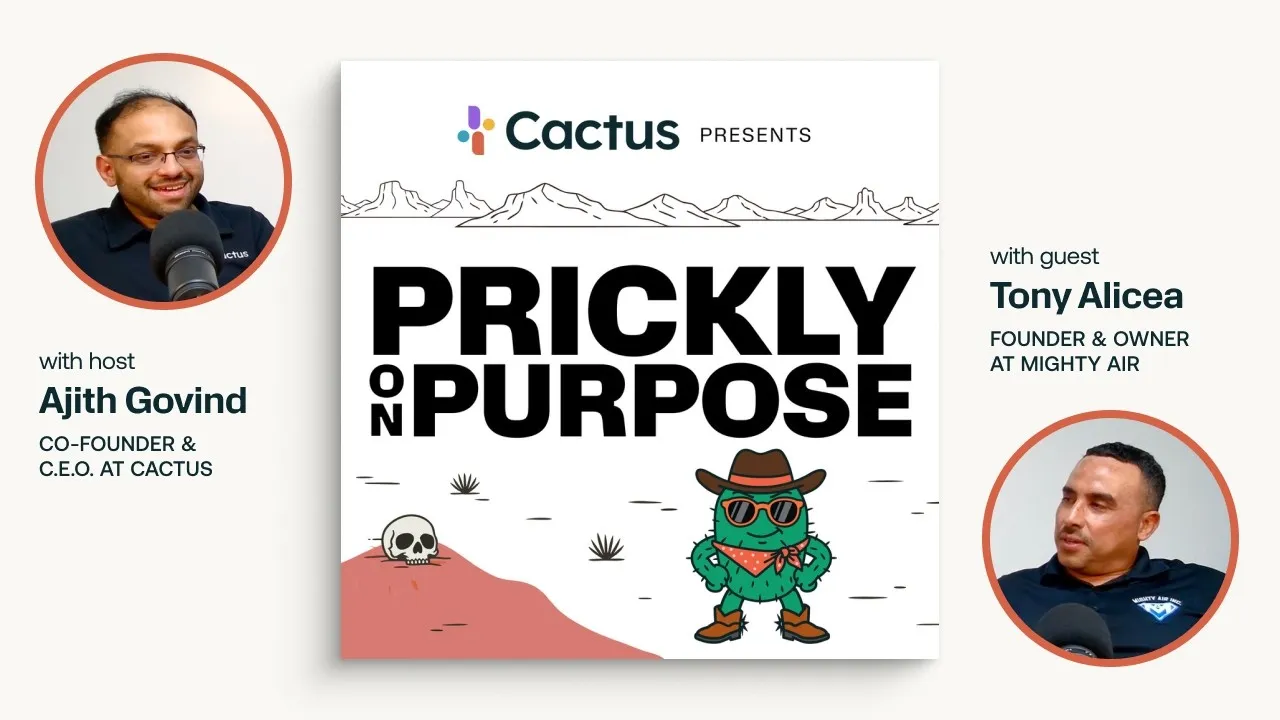
Why would an HVAC owner keep turning down private equity buyers? In episode 5 of Prickly on Purpose, recorded in Jacksonville, Florida, Cactus co-founder and CEO AJ talks with Tony Alicea, owner of Mighty Air, a family owned HVAC company, about staying independent and building a business around community.
In this episode
- Why Tony keeps declining private equity offers and plans to grow Mighty Air as a family business
- How he treats customers like family, including a story about helping one customer well beyond a repair
- How he went from working alongside his uncle at 12 to owning an HVAC company
- How weekly meetings and listening to his technicians built a culture people want to come back to
- How his team uses AI to write estimates, proposals and marketing
- Three things he'd tell anyone starting an HVAC business: learn the trade, learn marketing and learn to communicate
- What he learned from risky commercial jobs, and why contractors should help each other instead of going it alone
Chapters
The write-up
A conversation about staying independent in an industry private equity is circling hard, building a culture people come back to, and what it looks like to use AI without losing the personal touch that built the business in the first place.
Customers as family, not accounts
Tony’s philosophy starts with how Mighty Air treats the people it serves. “We treat our customers as if they’re family, they’re part of us,” he says. That’s not a slogan for him. It shows up in the follow up calls that happen weeks or months after a job is done, just to check in, and in a business that’s stayed family owned and operated for years in a market where that’s increasingly rare.
Being local isn’t incidental to that either. Tony has been part of the Jacksonville community his whole career, and he thinks that proximity is what makes the personalization real. A company that’s actually from a place, and stays in that place, treats its customers differently than one optimizing from a distance.
Nurture your own baby
Tony gets three to four emails a day from private equity firms. He turns them down, and he’s direct about why: “I believe that private equity is overrated.” He’s not interested in someone else running his business or telling him how to lead the people he’s built it with.
His reasoning is about ownership in the deepest sense. “If you have your own business, you can have the struggles, that’s your baby,” he says. “Nurture your baby. Keep watering the plant until the plant gets back up.” Every business hits hard stretches. His view is that you work through them yourself, with help from your community and network, rather than hand the business to someone whose exit clock starts ticking the moment the deal closes.
The goal on the other side of that decision is ambitious: $100 million, staying local and family run the whole way there. Beyond the number, Tony wants to start a vocational training school for young people in the trades, a way of putting something back into the community that raised him.
From a Bronx uncle’s basement to Jacksonville
Tony was born in New York and raised in Puerto Rico, moving back and forth to the Bronx as his father served in the military. HVAC found him early: an uncle in New Jersey ran his own business, and Tony started working with him at twelve, learning ductwork, basements, and gas burners. He describes it less as a job he fell into and more as something that kept the family close and gave him something to look up to.
That early exposure became a vocational school in Jacksonville, a high school diploma, a certificate, and years working for larger companies before Tony built Mighty Air on his own. He’s explicit that the business isn’t just work to him. “This is not my job, this is my passion,” he says. “I love being a superhero, fixing things.”
Spaghetti, cake, and a paint job
Asked for a story that’s stuck with him, Tony describes a customer on the north side of town with a failed AC compressor. His team fixed it at no cost. In return, she fed them spaghetti, and while they ate, they noticed the house needed work she had no one to help with. That same weekend, the team came back with paint and cleaning supplies and spent the day fixing up her home. They left with more spaghetti, cake, and a lot of warmth.
It’s a small story, but it says something about what Tony means when he talks about treating customers like family. It isn’t a phrase reserved for the sales pitch.
A culture people leave, then come back to
Mighty Air runs weekly team meetings, and Tony treats them as real listening sessions rather than status updates. His approach to leadership leans hard on humility: “If you always think you’re the boss, you will always think that they’re less than you,” he says. He credits a lot of the culture at Mighty Air to that shift, learning to slow down and actually hear his technicians rather than assume he already knows best.
The result is a culture that filters itself. New hires know within two weeks whether they’re going to fit, and the ones who don’t, leave. The ones who do sometimes leave for other opportunities and come back, because, as Tony puts it, they miss the culture. He’s candid that it isn’t a middle-path kind of culture. You either fit it or you don’t, and that clarity is part of what makes it durable.
AI without losing what makes it personal
As an early Cactus customer, Tony has a grounded view of AI in the trades. He uses it constantly, drafting estimates, emails, and social posts, and trains his staff to do the same. “AI is taught a lot,” he says of his own learning curve around business and finance. He doesn’t see it as a threat to jobs so much as a tool that rewards the people willing to get good at it.
The phones are where it shows up most concretely for his business. “It kind of gives us free time at nights to not have to worry about answering that phone,” Tony says. “We have an AI team that answers the phone for us, and quality calls will be transferred to where it needs to be transferred.” His take on the fear some owners have around AI is blunt: “Fear is just false evidence appearing real.”
Learn the trade, don’t be greedy, trust your gut
Tony’s advice for anyone starting a trade business comes down to three things: learn the trade itself, learn marketing, and learn to communicate. He’s seen too many owners who inherited or bought into a business with no real trade knowledge, treating it as pure sales rather than a craft they understand well enough to sell honestly.
He’s also lost real money learning that lesson the hard way, including roughly $90,000 tied up in a commercial project when a contractor went bankrupt, and a more recent job near Orlando that turned into a chain of unpaid obligations from builders to GCs to subcontractors. His advice isn’t to avoid risk entirely. It’s to price the risk properly and listen when your gut says no. “My gut kept telling me not to do it,” he says of one of those projects. “Even my wife is telling me. I’m just a risk taker, that’s in my blood.”
That same instinct pushes against scarcity thinking. “There’s plenty of money for everybody,” Tony says, encouraging other owners to build their own mastermind groups instead of guarding everything alone. “If I could feed somebody else, why not?”
Where this is going
Five years out, Tony sees Mighty Air at $100 million, still Jacksonville-owned, still family-run. Asked for the one word he wants customers to use to describe the company at that point, he doesn’t hesitate: service. “I’m always gonna be for the first,” he says. “At your service.”
These are Tony's views and experiences from the conversation, not a Cactus case study.
Transcript (lightly edited)
Speech-to-text of the published episode, lightly edited for reading: we removed short "yeah" and "right" interjections said over the other speaker and checked the names. Speakers: Ajith Govind (host) and Tony Alicea. Tap a time to play from there.
Read the full transcript4,970 words · 29 min
- 0:00 Tony
Whether you see it as a job, this is not a job, this is my passion. This is what I love to do. Not only that I love being technical, love nerd, love helping people. Uh, I love being part of the community.
- 0:24 Ajith
Welcome to Prickly on Purpose Podcast.
- 0:27 Tony
Thank you. Thank you.
- 0:28 Ajith
And we have today Tony Alicea-
- 0:31 Tony
Yes, sir
- 0:32 Ajith
The owner of Mighty Air. We are here in Jacksonville, Florida, and we are so excited to have you on the podcast, Tony. Uh, welcome, and thank you for being here.
- 0:43 Tony
Thank you. Uh, I appreciate you guys bringing me aboard. I appreciate this, uh, podcast. This, I think, is gonna be amazing.
- 0:49 Ajith
Absolutely. Absolutely. I'm gonna start right in, get right into it with a question about the way you treat your customers. I think it's so different, and would love to understand w- your philosophy on how you treat your customers and how you think about it.
- 1:09 Tony
Yeah. Well, I mean, it's more since I've, I've been in the field while here in Jacksonville, so it's kinda like, you know, it's, it... You have to be part of the community, so we're very involved. And so we treat our customers as if they're family, they're part of us. So we want them to have a company that they, that they could rely on and loyal, you know, and, um, and pretty much family operated. So we kind of bring that to the customer. We always check up on them. We always call them, communicate with them. Um, no matter, like, if they're waiting weeks, months, we always kind of just keep calling and, and trying to find out how they're doing, make it more personalized just because we are kind of local.
- 1:56
We're family owned and operated by, and we've been family-owned and operated for years. And so we're one of the few that's left here in, in Jacksonville. But, so we like to make it very personalized.
- 2:07 Ajith
Absolutely. Absolutely. Now, one of the very earliest conversations I had with you, uh, you mentioned that you have been approached by a lot of private equity. You kept declining them, and you, you mentioned it was very, uh, ambitious and, like, exceedingly audacious goal of hitting 100 million, right? And te- tell us, uh, why you believe in that vision, why you want to be family-owned and local versus joining, you know, the, the big private equity which can bring you potentially more revenue than this.
- 2:43 Tony
Yeah. Well, it will at the moment. I believe that private equity is overrated now. Um, and, uh, they're, they're kind of... If I'm gonna run a business, I'm gonna run it from my home to take care of my people. I don't believe in having somebody run me to show me how to run by people here in Jacksonville. So, so that's one kind of, you know, I'm, I'm just not a believer into working for somebody else, to make what works, that's already been working for yourself to make it make somebody else money. You know, so what's the purpose of that? Just, you know, there's always gonna be struggles in, in business.
- 3:26
Work through those struggles. There's people out there who can help you. This is the reason why pop has people that are locals, you know. It's, it's important. Be involved with the community. Be involved with them. Be, be, be around people that know your field to get some help. Don't get stuck or s- or sucked into this private equity, because once you're in it with them, it's like you're in it. You know, it's, it's either you're with them or you're not. The moment you mess up and you fail, it's like you're kicked out. You know, so why do that when, you know, if you're gonna work for somebody else, you might as well just work for somebody.
- 4:07
If you have your own business, you have your struggles. That's your baby. Nurture your baby. Keep watering the plant until the plant gets back up. You know, so just do it for yourself.
- 4:19 Ajith
Yeah. And, uh, tell us about the 100 million goal and the dreams that you have. Uh-
- 4:24 Tony
Oh, that's my big goal. So yeah, definitely I... And that's the vision I've had for years, you know. That's the reason why I kind of push back these private equities. They've come to me. I mean, I get at least three to four emails a day people-
- 4:40 Ajith
Every day?
- 4:42 Tony
I mean, I can scroll through my emails now and it's just people just trying to say, you know, this, a company that's interested in you and this and that. So we get a lot of those emails. But, um, but I see my... I see a vision as, as being part of the bigger and bigger companies here, locally owned and operated, but I mean in Jacksonville. And we're pretty much 100 million is where my max. I want to go above that, and that's where my vision is right now. So I'm not stopping till I get there.
- 5:15 Ajith
I love that. That's beautiful.
- 5:16 Tony
Or when you really give me that Rolex watch. Stop completely. But I, that's something that I see as a vision. And you know, I, I mean, I, I'm seeing it different. I'm trying to create a school, a training school for, you know, vocational, anything with young people. So I'm trying to do a lot for the community and help the community grow. It's not just about the 100 million. It's what I could do with the 100 million.
- 5:42 Ajith
Right. And te- tell us about why your customers need local companies and family-owned businesses versus the big corporates and private equities that are, that are running the business now.
- 5:57 Tony
Good question. 100%, we care You know, it's different. We, we, we've been there. We're from here. We know your situation. We care about you. You know, it's different. Private equity, you're just a number. They're just looking to maximize. They're looking for that higher ticket. They're training people to be sales. They're not training people to, to teach you or educate you or even prepare you. You know? It's all about sales.
- 6:26 Ajith
Yeah. That's, uh, that is true. And I think a lot of it comes from your, from where you are. Uh, and I, I, I know there's this beautiful story of how you are from Bronx. And, uh, tell us about how you got into HVAC and why this industry just kept you and, like, made you so passionate about it. Tell us about your backstory.
- 6:50 Tony
Yeah. The story's pretty long, so I'll keep it short. Yeah, I mean, I was from the Bronx. Well, I was born in New York, raised in Puerto Rico, but my dad being in the military, I go back and forth to the, uh, to the Bronx. But I had an uncle in New Jersey then, and he had his own business. And, uh, I worked with my cousins a lot when I was 12. He used to pick me up, and I used to work with him. And, and from there, ended up working in basements, gas furnaces. So I always looked up to him, to all that he had and how he built his business.
- 7:24
And that's something that, that I, that I kind of had grew a passion to it because I was young. He allowed me to help. He taught me a lot, me and my cousins. It kind of kept us as a, as family-oriented and kept us together. So that stays with me. He built that back then in New Jersey. So we always... We came to Jackson to a vocational school just to learn HVAC. Um, and I graduated with a high school diploma, got my vocational certificate, and, uh, started working for big companies out here. And it's, it's just my passion is different when you have a... When you see it as job.
- 8:03
This is not a job. This is my passion. This is what I love to do. Not only that I love being technical, love learning, love helping people, uh, I love being part of the community. You know, that's... So that made me build what I, you know, love the most, you know, is HVAC is what you can do. I love being a superhero fixing ACs. You know, customers loving you, hugging you, giving you treats just because of what you give is very helpful. And that's a great feeling.
- 8:31 Ajith
Yeah. Uh, I do have to say, we work with a lot of customers, but your branding and the superhero branding that you have, I am a huge fan of it. Um, tell us, tell us, uh, but, like, one of the stories that come to your mind about, you know, a, an actual customer who you helped and how it stays, uh, in your mind and-
- 8:54 Tony
I've got-
- 8:55 Ajith
Many stories.
- 8:57 Tony
Yeah. One main one was a customer in North Side. Um, and, uh, she, she of course had... It was hot and humid here. She had bad, bad AC issues and needed a compressor. So not only that, we got her AC back up running at no cost. She fed us spaghettis. I'm never forgetting that. It was the best spaghetti me and my guys that day. And while we ate there, we were seeing the things that she needed to be done, that needed to be done in the house as a project. And she had no kids or nobody to help her. So that same weekend, we told her, "We're gonna come out. We're gonna come and clean up your house and paint your house." So we showed up with the whole team. We went out there. We cleaned up her house, painted it, and of course, we got from cakes to more spaghettis to more treats.
- 9:47 Ajith
You're back for the spaghettis.
- 9:49 Tony
It was amazing. But, you know, it took one full day. Five of us, and we painted it, and, and it kind of, it just felt very, very warming to just know that this is the kind of things that people need and what we can do, and we're allowed to do this.
- 10:05 Ajith
Yeah. That's, uh, that's beautiful. I, I love that story. Um, y- your team, and let's talk about your team and culture. I think it's very unique. Uh, you have built a unique culture in your team. We saw that this morning with the way you run your team meetings and how everybody's working. Uh, was that intentional? Um, I know training is, uh, the big, uh, part of what you, what you like to do. Um, how does that all come together, and how do you make sure that the team cares just like you do for your customer? How do you, how do you translate that?
- 10:44 Tony
Well, it's, it's, it's comes with being part of it, talking to them. Having these meetings once a week is important because you're actually interacting with them, letting them see how each one of the guys that work with them, how they interact. Um, we're very involved. You know, of course, you have the wife. And she's, she builds something that, you know, kind of keeps everybody together. Um, and, uh, and we, we kind of go to that. They already expect for us to have fun. They already expect for us to talk about business, but at the same time, make it fun. So these are things that they, they, they kind of look for. And it's just an excitement you give them. You know? It's kind of hard to explain because you have to be part of it. So, so suggest anybody listening to this podcast that wants to come visit and be part of the meeting, come on.
- 11:39 Ajith
That's amazing.
- 11:39 Tony
Be part of it. And, and, and, and that's it. Just one-on-one, paying attention to guys. See, what happens is a lot of these technicians, they come and they go from company to company. You cannot... It's hard to find a technician that stays with you 100%. It's very lonely. It's hard to find that people. But if you keep up with them, communicating with them, it's, it's not about... See, I had to learn to kind of slow myself down and kind of put myself on another- Situation than just trying to think I'm the boss. 'Cause if you always think you're the boss, you will always think that they're less than you.
- 12:15
No, we can't. When you want people around you, and you want great people, even if they start from here, they will grow up to be the, that person you want them to be. Just listen. And I've been that listener and a teacher, you know? And, and, and that's what kept me with these guys earlier on. It's kept me with guys that just wanna stick around. I've got people that wanna come in and work with me, calling me all the time. Once they're already left but now they wanna come back because they miss our culture. And our culture is very important. We develop and took the time to kind of fine-tune that, and the people we hire have to fit that.
- 12:56
And, and they'll know. Once we hire a new guy, if within two weeks they'll know if they actually are ready to stick around this culture 'cause we all have that great energy. You know what I'm saying? You don't come with that energy, you gotta go.
- 13:12 Ajith
That's amazing, and I think it's a good lesson for even the people who are listening across all trades, but not just trades, but even startups. It's hard, right? Like, uh, building a culture is really hard, and I think what you're saying is you have a hard-core culture where you have to conform to it or you have to leave. Like, there's, there's no, like, middle path. There's no, like, dilution of that culture.
- 13:42 Tony
You have to stick by that. And, you know, and that's something that every on- every business owner needs to understand that you have to, once you got your culture developed, then stick by that. Because that's the only thing that's gonna make your business. You know, um, so it's important that they, they feed into that and get, get pointers from your employees. Get them involved you know, because you'll learn a lot more than you think. You know, I've learned a lot from listening more and talking to them more than for me to be stubborn and think, "Hey, I'm the boss." It's like, no, you can't get nowhere like that. So a lot of my culture and everything that we put together, not only the vices and the army, but within everybody in the team, they put things together to kind of develop that together, and we came up with this, this culture standpoint. You know, we all have to stand by it.
- 14:34 Ajith
And it is evolving. I mean, I think you've been saying that, right? Like, you're al- always constantly thinking about how to be improve that.
- 14:41 Tony
Always. 100%. Yes. You can't, you can never not think that you could improve better. You know, this, this is a business, and you always have to improve. You always have to learn, and you always have to listen.
- 14:54 Ajith
Yeah. Um, now I have to ask you this. We are an AI company, and how do you think about AI? What do you think is going to happen in the trades in the next, let's say, three years? How do you see AI changing the... If, if you think it is gonna change, right? How do you think about that?
- 15:14 Tony
I think the change is for the good. AI is definitely coming in as helpful material parts. It's helping people like me. I would say I'm from New York. My parents didn't know anything about literature reading, language arts. These are things that me growing into just knowing money knowing to trade, doing business, AI has taught me a lot 'cause I have a task and it teaches me. Um, but not only that, it's also giving away free way for anybody. Like right now with the, say, Cactus, with the phones, you know, it kind of gives us free time at nights to not to have to worry about answering that phone.
- 15:57
We have an AI team that answers the phone for us. You know, and quality calls will be transferred to where it needs to be transferred. That's the... You know, it can't get any better than that. If any business person does not think that's the right way to go, then they're not ready to grow. I'm gonna say it just like, you have to be ready to grow. In order for you to grow, let AI take over that perspective, and you'll see that it's gonna be so amazing. You got more time for yourself, more time, more time to think. So that means you could do a lot more.
- 16:32 Ajith
I love that. Yeah. Yeah. That's, that's awesome to hear from you. And of course, you're one of our earliest customers, so you have seen that, uh, as well. Um, the one that is interesting about AI is that there are, there are still a lot of people out there who think, uh, you know, is it weird, right? Is it, is it just gonna take over my business, and are jobs going to be lost? And what, what do you think will happen in the next three years, right? Uh, how do you think that market is going to change? And even with, for example, I'm sure, um, like do your technicians use GPT or anything to like look up things? How do you use AI, like in your, in your personal life?
- 17:17 Tony
Yeah. I, I use it on my page. Any kind of literature, any emails that are important that I need to put together, any estimates, any posts I use AI. I train my guys, uh, office staff to use everything, use AI for any conversational things, uh, doing ads. Um, so AI is, is a way of both to me. Uh, people, people have a rejection towards them because of, of loss of a job. No, I think if you're learning good enough, there is no loss of job. That means you get better at it every day. Just get better. Learning what's, what you can do with AI, learning the, the tricks of that trade you, you just could take over AI. But AI, AI is the best tool for all my guys. I tell them when you write an estimate- They had to go to AI to kind of script and correct.
- 18:12 Ajith
Oh, I actually know that wall.
- 18:14 Tony
Yes. And so they all have their tablets, ChatGPT. They all have the, you know, uh, all my office stats in order for, to create conversation, uh, of, of, of whether a campaign for any kind of reason. We use AI. It's been very helpful instead of us just thinking about it. Yeah, I mean, AI is the best tool to work ahead. Um, and, uh, I, I mean, to me, it's been a blessing to add it because it's been, been helping us a lot. Everything from campaigns, social media, marketing, um, and as far as now even on the phones. You know, this has been a helpful tool.
- 18:52
So I mean, you're always gonna have rejection just like everybody has a rejection certain foods. The same situation. You're gonna have people that deny, they're scared. Don't be that person that's fear. Be the person you learn more about to get involved with in order for you to create that stopping that fear, you know? Fear is just what's false that is appear real. That's thinking about it. You know, that's-
- 19:17 Ajith
That's, that's awesome. Um, I'm sure a lot of, uh, people out there are listening to you, and they wanna start their own HVAC or trades businesses, right? What are the three things that you would tell them that, "Hey, here are-- here's like three things you need to do before you get started and to be successful." What, what are the three things?
- 19:40 Tony
Learn to trade good. Um, learn to trade, learn marketing, um, and, and learn to communicate. You know, those are very important things. If you communicate well, you learn to trade very well. See, a lot of these company owners now, they have no idea about the trade. They're just owners from either a mom or a pop left it to them or they're corporately owned or something. They have no trade experience. To them, it's just sales. Communication is important. They need to learn the customer base communication. Um, and, and sales is okay to learn because you need your sales to work for, for, for you to grow your tickets, of course.
- 20:23
But this is so important for you to know the trade so you can sell a product you're trying to sell. Don't just go and sell stuff that you think is a possibility to grow your pockets because you're never to grow in the business that way. But yeah, for sure, the learning the trade is important and also learning how to communicate with your customers is very important. I mean, that's the only thing I can say because being in this trade is very tough. It is not as easy as everybody makes it sound 'cause it's a lot of learning. The growing terms and too many, there's a lot of curves to-
- 20:57 Ajith
Yeah. How, how long does it, uh, did it take you, uh, you know, to get to a stage where you're like, "Okay, now I have a real business" And talk us through, you know, maybe some of the struggles that you went through and how you basically overcame them as well.
- 21:15 Tony
Oh, yeah. Struggles are tough. Well, projects, uh, be careful in projects. Um, you know, I was involved in a lot of commercial jobs and kind of me being the, the boss wanted to go in and take that risk. Be careful with the risks. It's okay to take risks taken, but learn, learn about what you get involved with first. Um, I lost a lot of money in big projects and still to, still projects that still need, uh most contractors that went into bankruptcy that put me in debt for like ninety thousand dollars or more. Um, just recently we did a pool project, uh, pretty far out in Jacksonville, uh, down south in Orlando.
- 22:03
And, and we, you know, the way it turned out, they still owe money. It was a big old, big, uh, big loss there because of that situation. But it was from the, the builders to GCs to subs. So it became a whole big chaos. Even by putting liens, they don't have to pay. You know, because if they don't sell the building, it doesn't matter. You know? So study it and, you know, don't be scared if, if it's a job and you thought it's gonna be a lot to do. Price it out heavy enough for you to earn the money. And for you to make some money because those jobs like that are the riskier ones.
- 22:42
And follow your gut. My gut kept telling me not to do it. You know, and, and me being a stubborn guy, I said, "I'll do it. I can make it happen." Look what happened. Even my wife was telling me, "Babe, just do it." "Do it." And that's like, you know, those two big projects that I knew that I shouldn't have done. But still, I'm just a risk-taker. That's just in my blood. I love that. I'm gonna do it anyway. Anybody can tell me not to do it. Sure enough, yeah, shouldn't have done it.
- 23:15 Ajith
But, but you still knew that you shouldn't do it. That's the difference.
- 23:19 Tony
Shouldn't. I knew that I shouldn't. And I still did. But, you know, uh, uh, don't be a risk-taker. Be precautious. You know, when you're first starting this trade, learn how to take steps. Don't be a big jumper. There's no reason for that. And there's plenty of money for everybody. Do not be greedy. You know, work with the people to, you know, be around people that know the trade. Have friends that are contractors. You know, build your own mastermind team so that you could all help each other. There's no reason to be greedy and taking from this, taking this, this. There's plenty of money out there for everybody.
- 23:56
There's plenty of work for everybody. So I would say just, just make sure that everybody kinda comes together and communicate with that. You know, the contractors now, like I said, they're very, very- They're stuck in their own way. They, they learned to just grabbing is fine. But they build that because they see all the things that are happening. The equities coming over, they're taking over, they're scared they're gonna lose it. They've lost a lot, so now they're just all to themselves in a corner alone. I'm here to tell you, man, that's from me, we work together. I'm not greedy. That's one thing about me.
- 24:36
If I could feed somebody else, please.
- 24:39 Ajith
That is beautiful. And, uh, I was listening to a podcast, like, last couple of weeks, and it was from a billionaire, and he was saying that generosity is one of the most, uh, common traits of billionaires. And I was like, "Wow, that's, that's pretty cool. That's, uh, that's awesome."
- 24:57 Tony
And that had to come with him already because people think, "Oh yeah, he's generous because he's a billionaire." No. That's already in you. You know what I'm saying? You, you can't just develop that just because you're a billionaire. You know? It's been in, it's been in your heart. It's been in you. And that's how you grow into becoming a billionaire because you're generous.
- 25:19 Ajith
Because you are generous, absolutely. Um, ob- obviously you've gone through some very tough times. Um, and we spoke about this a little bit, uh, when, when you visited us in, in San Francisco. You do have a spiritual side of, of you, and h- how do you take care of yourself as, as a person, and how do you get out of those tough situations? Um, and how do you think of that?
- 25:45 Tony
Um, in terms of like, did you say spiritual?
- 25:48 Ajith
Yeah, like meditation and-
- 25:49 Tony
Yeah. So I mean, every morning I have a routine. I thank God. I do my affirmations, my prayers. You know, I do my pushups, do my stretches. You know, when we get to my age you've got to stretch every day 'cause you will feel it in the afternoon. You know? So it's a routine that, you know, some people always say that they don't have time. And they... It don't matter what time you wake up. There's times that I wake up later than normal, 'cause I don't know how, but lately I, for some reason I'll turn my alarm off and I don't even remember I turned it off.
- 26:26
You know? But that's the 11:00. I'm tired, but you know what? I still get up. I still do my routine, and I still make it on time. You know? It's just, just keeping yourself ha- eat- you know, eating good, having good habits, man, is important. Just keep your daily tasks. And you know what was, was, was taught to me a lot? Fixing your bed every morning.
- 26:51 Ajith
That makes a big difference, actually.
- 26:53 Tony
It does. People don't realize how much, how much that changes your life when you start doing it. But my mom used to quote me back in the days when I didn't do it. But that's just how I grew up. But doing that alone, man, that, that, that shows that you've been there. If you haven't done it and you start doing it, that change alone will develop something in you that you never think you had.
- 27:18 Ajith
And I think it's because it kind of breaks the inertia in the first thing in the morning that, okay, I'm actually gonna get things done. That is, that is beautiful.
- 27:28 Tony
And wake up smiling. Woke up, you know, it's another day. You know, don't frown. Don't worry about yesterday or tomorrow. The money ain't coming in now. Just wake up. Be smiling.
- 27:44 Ajith
Be grateful, I guess.
- 27:45 Tony
Yeah, be grateful.
- 27:45 Ajith
Be, be, be... That's what you're talking about, actually. Yeah.
- 27:48 Tony
Yeah. Be grateful you just woke up. Just, just smile and keep going.
- 27:53 Ajith
Amazing. Uh, I... Unfortunately, we are out of time, but we're gonna end with one last question. Um, it's five years from now. Mighty Air has hit $100 million. We are celebrating. What is the one word that you would want your customers to describe Mighty Air as? Just one word.
- 28:16 Tony
One word. One word or is it a sentence?
- 28:23 Ajith
Uh, let's, let's do a sentence.
- 28:25 Tony
Sentence? I've always said I'll always there when you need us, and that means I don't care if I'm at where I'm at now or up to 100 million. I'm always gonna be there for you guys.
- 28:37 Ajith
At your service, basically.
- 28:39 Tony
At your service. 100%.
- 28:41 Ajith
Awesome. With that, thank you so much for taking the time. Really appreciate it.
- 28:45 Tony
Thank you.
- 28:46 Ajith
And let's hit 100 million.
- 28:48 Tony
That's right. Let's make it.
- 28:50 Ajith
Awesome.
- 28:51 Tony
Up on that roller.
- 28:52 Ajith
Yes. Sounds great.