Prickly on Purpose · Ep. 2 · 34 min
The Cost of Growing Without Boundaries: Ryan of Upfront Services
Published on YouTube
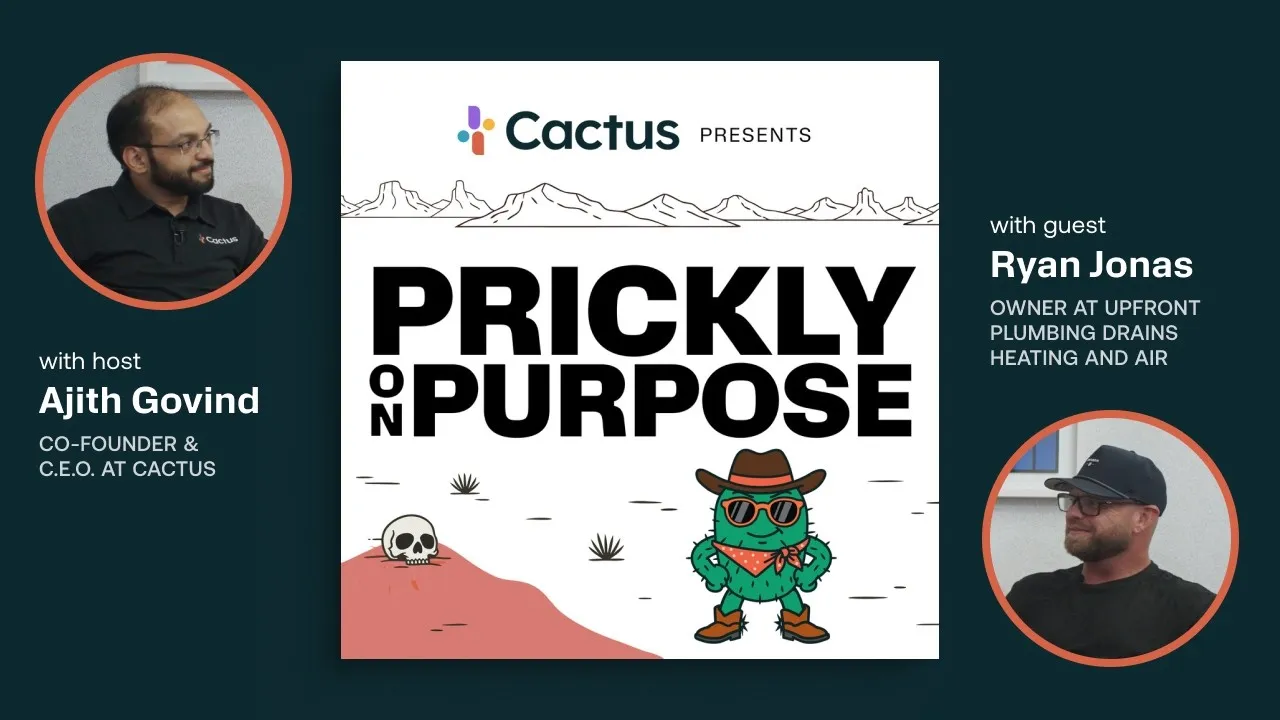
What does it actually cost to grow a home service business? In episode 2 of Prickly on Purpose, Cactus co-founder and CEO AJ talks with Ryan, owner of Upfront Services, a plumbing and HVAC company serving Salt Lake City and Boise, about scaling without giving up the rest of your life.
In this episode
- Why a private equity buyout of his former employer pushed Ryan to start his own company
- How referrals and an existing client base brought in his first jobs
- Why Upfront doesn't run on-call weekends for plumbing, and how that decision helps keep technicians
- Why he tells technicians to let their work earn reviews instead of asking for them
- Where he sees AI taking over repetitive CSR work so his team can move into bigger roles
- His plan to help local companies stay independent instead of selling to private equity
- Three things he'd tell owners stuck at $2 to $3 million: take risks and push past your limits, stick to a process, and build culture
Chapters
The write-up
In this episode of Prickly on Purpose, Cactus co-founder and CEO AJ sits down with Ryan, owner of Upfront Services—one of the fastest-growing plumbing and HVAC companies in Utah and Idaho. It's a candid conversation about what it actually takes to scale a home service company past the ceiling most owners hit, and what it costs if you scale the wrong way.
Calm is built, not born
AJ opens by asking the question most founders never get asked: how do you stay calm when the job is chaos every single day? Ryan’s answer isn’t a mindset hack, it’s an org chart. “I have the flexibility to run the business versus work in the business,” he says, crediting a strong team he spent years building out. Early on, he wore every hat himself—payroll, dispatch, sales, customer service. The calm showed up only once he had people in place to own those functions, freeing him to operate at the owner level instead of the technician level.
It’s a distinction worth sitting with: the businesses that feel most in control usually aren’t run by the calmest people. They’re run by people who built systems that don’t require them to be everywhere at once.
Draw the line before growth draws it for you
The most pointed part of the conversation is about boundaries. Most plumbing companies run calls 24/7, weekends and holidays included. Upfront doesn’t. Ryan calls it the Chick-fil-A model: “If you’re a good enough technician and a good enough plumber, you shouldn’t have to work weekends to make your living.”
“It was more of an obsession to me. It dismantled my personal life in a way that I’ll never forget. I missed out on a couple of years of my daughter growing up. My marriage fell apart.”
That decision wasn’t theoretical for him. As a technician, before he owned the business, he took three days off in an entire year. Every operating decision Upfront makes now (no on-call weekends, techs home by six) traces back to that year.
It’s a sharper version of a principle every founder eventually has to confront: growth doesn’t ask permission before it eats your calendar. If you don’t decide where the line is, the business will decide it for you.
Let the work speak for itself
Ryan is proudest of an award he says can’t be bought; Best of SLC, decided purely on Google review volume and rating, two years running. He contrasts it with how his industry usually operates: technicians trained to ask for reviews, incentivized per review, sometimes literally paid for them. Upfront does none of that.
“I tell my technicians let your work speak for itself. The last time I leave a Google review, it’s completely unsolicited, I just loved the experience. That’s usually how everybody does it.”
It’s a quiet rebuttal to a lot of growth advice: the fastest way to build trust at scale isn’t to optimize for the metric, it’s to make the metric a byproduct of doing the work well.
Three things for owners stuck at the ceiling
Asked what he’d tell an owner plateaued at two or three million, Ryan doesn’t hesitate: risk, process, culture. Take the risk that “don’t grow too fast” advice tells you not to take. He financed five vans before he had the cash cushion to feel safe about it. Build process and stick to it, rather than bending payroll and structure every time you’re afraid of losing an A-player. And build culture, because it’s what makes accountability and expectations actually land. “Culture breeds success,” he says.
Where this is going
Upfront is projecting $15–17 million within three years, partly through its own growth and partly through small acquisitions—Ryan’s second in two years. But the ambition underneath the number is more interesting than the number itself: he wants to help other local, independent operators compete with private-equity roll-ups that can out-negotiate everyone on vendor pricing but can’t out-culture a business that’s actually run by the people who built it.
Watch the full conversation for more on how Ryan thinks about AI’s role in home service, including why he’d rather see it take over repetitive CSR work than replace people outright.
These are Ryan's views and experiences from the conversation, not a Cactus case study.
Transcript (lightly edited)
Speech-to-text of the published episode, lightly edited for reading: we removed short "yeah" and "right" interjections said over the other speaker and checked the names. Speakers: Ajith Govind (host) and Ryan. Tap a time to play from there.
Read the full transcript5,842 words · 34 min
- 0:00 Ryan
It's personal development um, for an owner is absolutely critical. Pushing yourself, getting in rooms you're uncomfortable in, that's, that's a huge part of that. So I, I wanted to do something uncomfortable. I didn't want the mediocre, you know averages. I didn't want to be another average. I wanted to be some- somebody that stood out.
- 0:30 Ajith
Welcome, everybody. My name is AJ. I'm the co-founder and CEO of Cactus. Welcome to the podcast, Prickly on Purpose. Today, we have Ryan, who is the owner of Upfront Services from Utah, one of the fastest growing plumbing and HVAC companies. And, uh, this is going to be a prickly conversation. And Ryan, we are so excited to have you here.
- 0:56 Ryan
Thank you.
- 0:56 Ajith
Welcome on to the podcast.
- 0:57 Ryan
Thank you. Thank you very much. It's an honor. Uh, been working with you guys for about a year, so it's been great to get to, uh, you know, nurture the relationship and, and be here. So thank you.
- 1:09 Ajith
It... The, the pleasure is ours. Um, we'll start with the question which, uh, I think nobody asks, and that's the... The question is, how do you structure your day when it is so chaotic in your field every single day? And we work with so many business owners, and it's even hard to, like, talk to them for, like, two seconds. But you seem, like, to have an aura, a calm, and how do you manage to do that?
- 1:41 Ryan
You know, uh, the way I manage to do it is built a strong team. And so, like, I think now, um, especially in the last two years, uh, my days have become more structured that I have the flexibility to run the business versus, uh, you know, work in the business. And so h- for me, where I'm at today, it would look a lot different five years ago. So when you're founding a company, you're doing everything, so wearing 10 different hats and, you know, from payroll to CSR stuff, to, you know, account management, customer, uh, acquisition, everything. You're doing everything. So now I have people in place that handle most of those things, and so I get to operate the business at, uh, you know, an owner level, is what I look at it like.
- 2:28
And, you know, I, I, I, uh, I, I'm not the best at structured days. One thing that I will say is that it's a learning experience, and every day has challenges that are different r- than the day before. So, you know, it's, it's kinda learning how to go with the flow of things and get a little bit thicker skin so things don't affect you as much. You know, there's big incidents that happened at work over the last five years. I could tell you many. But I think the calm is because I've dealt with most of the, the big things in business and been able to work through them.
- 3:05
So, um, yeah, I, I think, I think just finding a groove and, and learning that something's going to happen every day is is the biggest thing.
- 3:15 Ajith
That's amazing. And that is the thing that we as founders try to get to as well from our side. Um, now for everybody, Ryan scaled the business from absolute zero, scratch all the way up to now what is it, nearly 10 million, uh a year? Your-
- 3:33 Ryan
Fifth full fiscal year, so January to January, um, we will do projected at $10.5 million.
- 3:40 Ajith
Wow. Now that, that's quick, right? That's such a short time.
- 3:44 Ryan
It's quick.
- 3:45 Ajith
Can you tell us a little bit about how you got started and what inspired you to start this? And y- I, I, I feel like everybody needs to have, like, a intense fire in them to go through this journey of growth. And what really motivated you or propelled you to put in those 18 hours and 20 hours and put your life into this?
- 4:07 Ryan
Yeah. Um, you know, so there was, there's a, there's a big story about private equity that came into Utah. And I'll tell you, I was never focused on opening a business when I was working for other people. Um, so it was more, uh, out of necessity because private equity came in really strong in 2020, um, purchased the business that I was working for. And, you know, if, if they would've stayed owners, I probably would've retired at this company. They treated me very well. Um, a lot of good things to say about how their operations were. So my push was when I saw private equity come in and really take over the day-to-day, and people became numbers, and it was pretty much overnight.
- 4:51
You know, there was a lot of commitments and a lot of things told to us that we're, you know, we're gonna keep the company the same. Everything, you know, is gonna run the same, just different owners. That didn't happen. So I, um, you know, even at that, uh, previous company I, I brought on some close friends that are now employees, and they've been with me since I brought them on to that other company. Um, so for me it was about the people and, and what, like, a company should look like. None of us want to work in white collar fields. N- no blue collar guy that I've met that's in the industry
- 5:28
That, that it's, uh, a career wants to work in a field where you are run by corporate enterprise. And so that's what the drive was for me. Like, I, uh, you know, I, I made phenomenal money as a technician. I was really good at sales, and so I was very comfortable. Um, really it's a huge risk to open a business. I, um, I understood that. Um, luckily I was financially stable enough before I started the business to make that happen quicker. But I mean, for me, it was more of a need to take care of people. And, you know, at the core, like, that's what this business is built around is, is the team around me now.
- 6:09
You know, I, I think at the end of the day, we all get to say we contributed our own part in that, and it's really cool 'cause I have some employees that have been with me since day one. And, you know, a lot of employees came and left, and that's the story for everybody. But at the same time, like, I've been able to help those people that started this with me grow into... I think every single person that I'm talking about right now is above a six-figure income as plumbers and as excavators, and, you know, those types of things are, are what I track.
- 6:40
People's life i- i- improves and their pay improves. That's how, that's how you wanna grow in a field. So yeah, it's, it's, m- it's the people. The drive was the people around me, and I, I did it for somebody other than myself.
- 6:55 Ajith
And that, that's very, that's very motivational for us, and inspirational. And it's... I, I also h- heard you saying that we support 50 families and how that is so important to you. Um, how did you get to this idea like, "Okay, I can start a company on my own," right? "And get to this scale." Did you, did you manifest it this in the way that, "Hey, I... One day I'm gonna hit 10 million," or, "One day I'm gonna get, like, five million, 100 million." Like, what, what is the thought on day one? Like, so it's day one, right? What did you think? What happened in your business?
- 7:33 Ryan
So day one, um, I just had a point to prove. So I got pretty comfortable running a multimillion-dollar, um, side of a business. So scaling to 10 million wasn't, like, a scary deal to me. I've seen it done. I knew I could do the same things. Um, before I got into plumbing, I was in, uh, sales, and it was a corporate environment. I learned a lot, um, of business etiquette and process and, you know, from the office. I was on the phone selling, uh, tech equipment. Um, that gave me the ability to understand the business at a different level than most blue collar, um, people that I was working with.
- 8:14
And so scaling to 10 million was something I knew I would achieve 'cause I've seen it done before, and I could duplicate it, right? I was given the ability to manage other companies at h- a high level. So now I think the real challenge for me is pushing past that mark and understanding how that looks because this is unfamiliar territory. So for me, it was, it was more about following what I've learned. Um, and now I'm past the point of where that company was, and, um, now it's in uncharted territory. So the 15 to 20 million mark is obviously our next goal. Um, you know, and, and I think this is where s- things are starting to get fun.
- 8:58 Ajith
Yeah. And I'm sure you've gone through some dark, deep days, uh from the journey till, like, zero to nine million, and now you get- going to hit 10 million. What, what were the, the scariest parts? Was it, was it from the zero to first million? Like, how did you even get the parts, and how did you get to a place where, uh, you could, you could work with suppliers? And just walk us through, like, maybe your first customer. How did that happen?
- 9:26 Ryan
Yeah. So luckily, like I said, I was able to manage at a high scale, and so I had a pretty big black book, uh, like, already built up through my customer base from previous employers. So I had people that called me directly. They only wanted to work with me. I had some pretty big loyalties. Real estate agents are a huge kick. Right? So, like, even the $81 or $99 inspections that we were doing, it fed us bigger jobs because there was issues that needed to be taken care of. You know? So, um, having a, a, a book of clientele before you start a business is a trick in itself, and it will project you a lot quicker into getting referrals and, you know, i- having your name out there just with other people's, um
- 10:13
You know, if you do good, good work for somebody, most of the time they'll shake your hand and tell you thank you. And then they'll turn around and refer you business. So that's a lot of how my business was built, is based off referrals and, and doing good business with people and being honest. You know, I, um, there's a lot to say about the trials that it took. I think every day I have doubts and concerns and you know, everything that comes along with business ownership. I'm, you know, technically, if you look at it a certain way, I'm millions of dollars in debt and kinda holding on by the seat of my pants.
- 10:47
But at, at the same time, I get to operate a multimillion-dollar business, and that's more of a gift to me. So I think, you know, saying all that, how you get through it is, you know, you have to reflect and be grateful for the opportunity 'cause a lot of people don't get to experience this in that way. So, you know, there's, uh, there's something I like, I like to think about. I can't remember the exact saying, but, you know, everybody's always striving for more, and you're in somebody's shoes they dream to be one day. So I think if you, if you can take a step back and realize, like, I'm in a spot that a lot of people don't get the opportunity to have
- 11:26
Everything kinda comes together. So, you know, being grateful through those moments is critical.
- 11:33 Ajith
I love that. And, uh, I think for me as well, and Avinash, who is my co-founder and C- uh, CTO, gratitude and being grateful is a very big part of our lives, and I think it's something which every successful person has, like, as one of their core philosophies of being, being grateful, being generous, and being open-minded and all of that. So that's, that's really great. Now, one of the things that Ryan has recently very, uh, uh, strongly influenced me is to, uh, have a morning routine, and I think I wanna talk about this with Ryan. Like, just tell us how your day starts, at what time it starts, what do you do, uh, and yeah.
- 12:15 Ryan
So my day starts at 3:00 AM Um, you know, do my morning stuff and then I end up going to the gym. I have a home gym, and then I have a gym that I go to, uh, three or four days a week as well. But, um, part of this ownership journey has also been like a, a personal health journey too. Um, you know, being on the road as a technician, you don't really get to stop for lunch. You stop at 7-Eleven and get a hot dog or one of them chicken sandwiches that are absolutely disgusting. But they work. And so it's a really unhealthy lifestyle.
- 12:51
So for me, my morning routine means everything. I, I think in the last six years I've probably missed under two weeks of doing something, some sort of routine, some sort of physical routine. Um, whether that's elliptical or 30 minutes on, on the bike, something simple. But that sets my day. It's kinda like making your bed. Right? One of those first things when you wake up, make your bed. It gets the first action out of the way. So for me, that's what, you know, going to the gym and, and that routine means is I'm starting my day off on the right foot. Right? So no matter what the chaos is, no matter what happens after that, I get to say I did that one thing the right way, you know?
- 13:35
So I think that's, that's the biggest deal for me with my routine is the consistency that it takes and the, the commitment that it takes. It makes everything else in the day easier.
- 13:47 Ajith
And that's something that, uh, we have noticed with many of our, uh, customers that we work with, that they have a routine which they swear by and they never kind of deviate from that, right? So um, you always talk about a way of life for business owners and for, uh, especially like, uh, people who are scaling, right? From two million to five million, and five million to 10 million. Because at some point, I think money is going to be sufficient or like comfortable or like g- good enough. And then I think it starts becoming the question of, do I miss this evening with my kid? Do I cancel this date night with my wife? And so on, right? So can you tell us a little bit about what the way of life is, and it should be for business owners, and how do you get there?
- 14:38 Ryan
Yeah. Absolutely. So I actually like designed ... So a lot of plumbing companies, HVAC is different, but I'll speak for plumbing. So we started plumbing first. Um, a lot of, a lot of companies are 24/7, uh, weekends, holidays, they work every single day. So when Upfront started, when I was, uh, running calls and doing a lot of the work myself, I chose to run weekends. But, you know, I started to think about, you know, how much I had to work as a technician and what it did to my personal life. Um, and so when I hired my first technician, I made the decision to not do on-call weekends. We do not run calls on weekends. We are not like a 24/7 company.
- 15:23 Ajith
It's, it's like the Chick-fil-A, uh, model. I love that. That's great.
- 15:26 Ryan
Yeah, so a lot of companies thrive on those weekends, and my philosophy is if you're a good enough technician and a good enough plumber you shouldn't have to work weekends to make your living. Um, so we haven't done on-call weekends for plumbing. If emergencies come in and it's a big customer, I'll make some phone calls to my guys to try to take care of people. That doesn't go away. But we, uh, we, we made that decision and I will tell you, I have a lot of loyal plumbers because that way of life is established through those decisions, right? And so like an owner perspective, like for me, like I have to find that time that I can block out with my family because, frank- I'm on the phone 24/7.
- 16:10
Like, something's going on always. Our communication's through the office, everything. Um, so now I have to be a lot more intentional because the workload, although I get to choose a, a little bit different things and do different things every day the workload has intensified. That's something that always happens. When you scale, you get more work on your plate. Um, so I think the way of life for me is, is more about like showing others, um, like that you can have both. You can have a good living, you can have a good life, and you can have a home life. So for instance, like my last year that I worked as a technician, I think I took three days off total.
- 16:54
That's weekends, everything. I made a lot of money. But it was more of, it was an obsession to me, and it dismantled my personal life in a way that I'll never forget, and I don't I don't want that for people. So that's what it really is for me, is it, it ruined a lot of things. I missed out on a couple years of my daughter, uh, growing up. There were some things, my, my marriage fell apart. Um, and there's a lot of accountability that I got to take when that happened. Um, so now I choose to do things differently. And simple operational models, not working on calls and having techs at home by 6:00 at the latest
- 17:33
That's a big deal for me. That, you know, promotes a culture that I believe in. So it's, it's little decisions. It might be very scary for some people to not take an on-call water heater mainline backup or something critical. For me, I can usually talk to those people about avoiding the after-hours fees and still keep them on my schedule. So I've found a way to do both. But I don't, I don't think running calls every day, all day is good for culture. So.
- 18:03 Ajith
No, we, we believe the same thing and if you want to do something for a long time then you sh- you cannot like burn out, you cannot kill yourself. And, uh, that, that, that is the whole point. Um, yeah. Completely agreed on that. Um- We are an AI company, of course, uh, so I have to ask you this question. Uh, how have you seen AI, uh, change the industry in the last, let's say, six months, 12 months? Uh, where do you see it going? I remember you, uh, painting a very, very futuristic vision when we first spoke in the very first call. Do you still believe in that vision, and where do you see that going?
- 18:44 Ryan
I do. I think, I think a lot of people are intimidated by the AI movement. I'm more excited, um, than anything, just simply because I think it's a way to improve people's performance and then give them o- other opportunities when you can have a system doing the simple stuff. So in all reality, my personal opinion is that people should scale as AI i- is implemented through your companies. So, I mean, AI is making a big impact in the service world. There's a lot of things going on, and there's a lot to be said about, you know, different companies coming in, and, um, what it can do for the way of life.
- 19:24
That's another factor. How do we implement something that can give these people a better way of life and not make it about the money first? So AI is, is phenomenal. I hope to see one day where we don't have to hire CSRs. And my reasoning for that is because I think people are, um... They have more opportunity to scale into bigger roles if those things are handled. Obviously, there's a, there's a double-edged sword that comes with that. Some people don't have the ability to scale, but, you know, they should find other opportunities that will suit them, and yeah. I think AI's... I think if people fight it, they're, they're just on a losing slope because
- 20:10
It's, it's coming quick no matter whether we like it or not.
- 20:13 Ajith
Now, uh, we have been in this industry for about a year. Uh, one of the things that we have noticed is some of the roles in the business are a lot of grunt work, and there's a lot of manual work, which I think AI can help out a lot, right? Um some of the jobs like CSRs uh, which we have spoken to, like, a lot of people, they're like, "This is the highest attrition job. It's so hard to keep them in a job." Do you, do you see that, uh, happening?
- 20:42 Ryan
Absolutely. It's, I mean, it's... To me, it's similar to any other entry-level job. This is a very straightforward entry-level jobs. You're gonna get people just entering the workforce, a lot of young kids. Um, you know, and, and we've actually been able to adopt a system that the gals work from home. So we have an at home work off- office balance and, um, you know, I, I think, I think... Uh, so for instance, my girls, they call every lead every single hour. Imagine what they could do if they had some time to focus on quality things versus the repetitive, you know, dialing and messaging and whatever that looks like
- 21:27
For the hour. But they have an, an extreme amount of workload when we have a lot of leads that can easily be taken over by AI. So the flexibility of that, now I get to progress them into something else. You know, now I get to shift them into bigger, more meaningful roles. That will take that equation of, you know, the entry-level role out of it. 'Cause the attrition rate is... Every company I've worked at, regardless if it's in a plumbing world or corporate world, those entry-level roles are incredibly high turnover. And, you know, my attrition rate would be really good if I didn't have an office.
- 22:05
But, you know, I, uh, it's also the hardest to manage. Um, so that's something that it gives relief on both sides if you can if you can have less to manage with that. So there's some big perks, but I think the attrition is always gonna be there at those types of roles.
- 22:22 Ajith
Right. When we first entered your office, um, I remember seeing, like, all these awards, and I think awards are a big thing in the industry, and almost everybody, uh, you know, tries to get them. But you mentioned something which caught, like, my attention, uh, because many of customers have, have the awards, right? But there was this one award where you said that you cannot buy this award. Right? And tell us about that, uh, and that was very intriguing.
- 22:51 Ryan
So that was the Best of SLC award. Um, so that is based off Google reviews. And so, uh, that was my first bone to pick with private equity. Um, they train their technicians to ask for reviews. Um, they spiff them if they give reviews. I don't do any of that. I tell my technicians, "Let your work speak for itself." Um, for the last two years, and I'm trending for a third 'cause I watched the other competitors. Um, we should y- win it for year three in a row, but that is based solely off Google reviews. So earning that for two years in a row, to me, that was the proof that you didn't have to follow this cringey process of
- 23:35
Some guy in your house like, "Hey, I get 10 bucks if you send me this review. Can you do that for me?" I don't, I don't believe in that. Let your work speak f- speak for yourself. We do happy messages too, so we ask the customers how their experience was. We do follow-ups like you should. Like, you should care about the experience. But also, those reviews speak for themselves. We don't... W- I don't train my technicians to ask for reviews, so that w- that's a really rewarding, uh, um, thing for me with the Best of SLC because there's a Best of State too that you actually have to purchase into.
- 24:10
I don't enter those because I don't believe in that type of system. But the Best of SLC you can't enter. You get nominated, and then you win or you don't win. So pretty rewarding to see that based off of that one factor is the Google reviews.
- 24:25 Ajith
Yeah, and, and what that tells me is that- Your service is exceptional that people just go there and do it. The last time I've- like, any time I do a Google review is when it is completely unsolicited. And I just love the experience. And I'm just going to go there and, like, give you a review, right? That's usually how I think everybody does it. And especially when somebody is in the house and they ask for it, and I remember, uh, Avinash saying this that everybody asks and it is just like a big turnoff.
- 24:55 Ryan
It's a turnoff.
- 24:56 Ajith
It's a big turnoff. Uh, and yeah, I mean, uh, this is, this is something which I think all home service business owners should, should be listening to, right? So this is, this is really big. Um, what does, what does, uh, Upfront look like in three years? I know you've already expanded to, like, uh, Idaho. What's, what's your vision? Is there a number in your mind where it should be? What's, what's, what is, what comes to your mind?
- 25:22 Ryan
So my goal for Upfront is to find a way to partner with other brands in our current markets. We're in Boise and we're in Salt Lake. Um, Upfront itself, um, has a lot of potential. We just scaled into the commercial market. Our commercial guys are killing it right now, so I think that's gonna scale very well. Um, so for Upfront specifically, I think the next three years we should be around the 15 to 17 million mark based, based off my projections. But, um, for the team that we have, we have some pretty special people in the industry, um, that I think can help more people than Upfront can employ.
- 26:09
So now I'm looking at doing small acquisitions into other brands. Um, just did my second one in two years. Um, and so scaling for Upfront looks like helping other companies scale that don't have some of the, uh, you know, understanding of business and marketing tactics, things like that. I see Upfront expanding 'cause we also- something about Upfront is that we do a lot of subcontractor work. We do se- sewer work for about seven to eight companies um, in Utah's market right now, because we have some equipment and some crews that are, um, pretty established. And, um, so for Upfront, I wanna be a leading factor of keeping local companies local.
- 26:57
So, um, now I wanna go fight private equity, all those big groups. Like, I, I, uh, my intent with this is to bring local companies back. And so not being overtaken by private equity, and show them the things that they know in business that some of these operators just don't understand, so. That's the big opportunity for Upfront, is to expand our reach into other brands and really formalize process and procedure throughout. Um, and then we can scale them into something noticeable as well.
- 27:32 Ajith
That's amazing. So you are, you are wanting to help business owners stay independent and help them grow, and essentially win the fight against private equity who who has infinitely more bigger marketing budget-
- 27:50 Ryan
Huge
- 27:50 Ajith
And, uh, everything else, right? So that's-
- 27:53 Ryan
Nobody-
- 27:53 Ajith
The vision you're looking at. Okay.
- 27:55 Ryan
Nobody can compete with some of those things. The way they're able to negotiate with vendors and uh, different brands. HVAC specifically, their, their pricing is better than any of us, and they, they have a dog in the fight because the amount of spend that they can you know, offer with 10 different brands. We don't have that. We have, okay, we can do a couple hundred thousand. Can we get some better pricing? And, you know, I've even heard, um, vendors say that they can't match their pricing because we don't have the, the spending power. So yeah, very intentional with that. I- it's, it's close to my heart, um, to make sure that that fight is at least taken to them in some sort of way.
- 28:38 Ajith
Absolutely. And we have a lot of, uh, customers who are business owners, uh, who are stuck at the ceiling of two million, three million, and they're struggling, right? It's- uh, they don't have a lot of money to put away and, uh, it's chaotic every day. What would you tell them, let's say, three secrets, right? That they can make their life a little bit better from your, from your perspective.
- 29:02 Ryan
Yeah. So, uh, you know, I, I think taking risks is huge. Um, you know, I, I have a couple friends that got me into the industry. Um, they're both business owners, very successful. Um, a lot of kudos to them. But, you know, when I first started, um, I got told, uh, by these gentlemen that, "Don't grow too fast." Uh-
- 29:26 Ajith
Well-
- 29:26 Ryan
"... and, you know, grow slowly over time is the best route." And I, I- I'm, I'm very much into risk-taking. Um, and so I think, I think understanding how you can improve past your own mental, uh, constraints is, is really a big part of people's growth. And, you know, there's a lot of risks that I took, whether that was going to finance five vans and filling them, and hoping and praying it would work a lot of the time. Obviously, process is huge. I'm very big on that, and so I had structure with that. But those risks are avoided a lot of the time by, by owners because it's such a financial, like, risk, right?
- 30:12
So, like, when you go and finance $300,000 worth of vehicles you don't have 100 grand in the bank. It's really scary. Like, if you're upside down for the first few years, a lot of people look at that like, "When do I get to start making money?" I looked at it like, I don't get to take money until everybody else is fed and my, um, my targets are hit. So- Everything, every dollar for the first couple years was invested back into the company whether that be equipment. I mean, our sewer equipment alone was $400,000. With the trucks and excavators and everything. We have a lot of that equipment.
- 30:50
So I was, I was really foot forward, um, with those types of risks because I knew what I could do with it, for one, and I knew that was the path that I wanted to take. I didn't want a slow million here, million there. No, I, I wanted to get to where I knew I could get. So taking those risks is huge. Personal development um, for an owner is absolutely critical. Pushing yourself, getting in rooms you're uncomfortable in, that's, that's a huge part of that. So I, I wanted to do something uncomfortable. I didn't want the mediocre, you know averages. I didn't want to be another average.
- 31:30
I wanted to be some- somebody that stood out. That's how you get there is you take the risks.
- 31:34 Ajith
Right. To be exceptional. Yeah.
- 31:36 Ryan
Exactly. So that would be the first thing is, is personal development. You know, pushing past those limits. Um, process and, and structure. You have to have a process and you have to stick to it. If you fluctuate, things like a lot of companies you'll see change their payroll because people aren't making enough. Instead of coaching them and showing them how to make enough money in this industry, people and owners are very, uh, flexible when it comes to when they think they have an A player, so they need to accommodate them instead of show everybody in the room how to get to where you know they can get. So process, um, is huge for that. Um, so that would be the second thing. And then the third thing.
- 32:29 Ajith
We need one more.
- 32:30 Ryan
We need one more. Definitely. Definitely culture. Creating a team, and that, that goes into the training too, like helping people develop over time is, is one of my most favorite things of this. I can tell you you know, those handful of guys that have been with me, I've seen their pay increase personally. Um, to, uh, they're, they live a comfortable life. They get to play a role and they get to lead other people. So I think everything, everything relies on culture. 'Cause then you can have accountability, then you can have expectations that are set properly, and people understand why you're doing what you're doing. So culture breeds, uh, success is my opinion.
- 33:16 Ajith
No, that's amazing. So to summarize, take risks, uh, don't play it safe, work on your personality development, on your personal development to become a better leader and, uh, invest in making culture a big part of your success. That's, that's what plays success.
- 33:34 Ryan
Huge.
- 33:35 Ajith
Yeah. And of course, wake up at 3:00 AM as well, so.
- 33:37 Ryan
Yeah. That's important.
- 33:41 Ajith
Awesome. On that note, Ryan, I think we are out of time. Uh, it was so great to have you here.
- 33:47 Ryan
Thank you.
- 33:47 Ajith
Um, and we of course love working with you and, uh, looking forward to that. And of course, thank you so much for being on the podcast.
- 33:55 Ryan
Thank you.