
Guide · November 23, 2026
How to track home service marketing ROI all the way to paid invoices
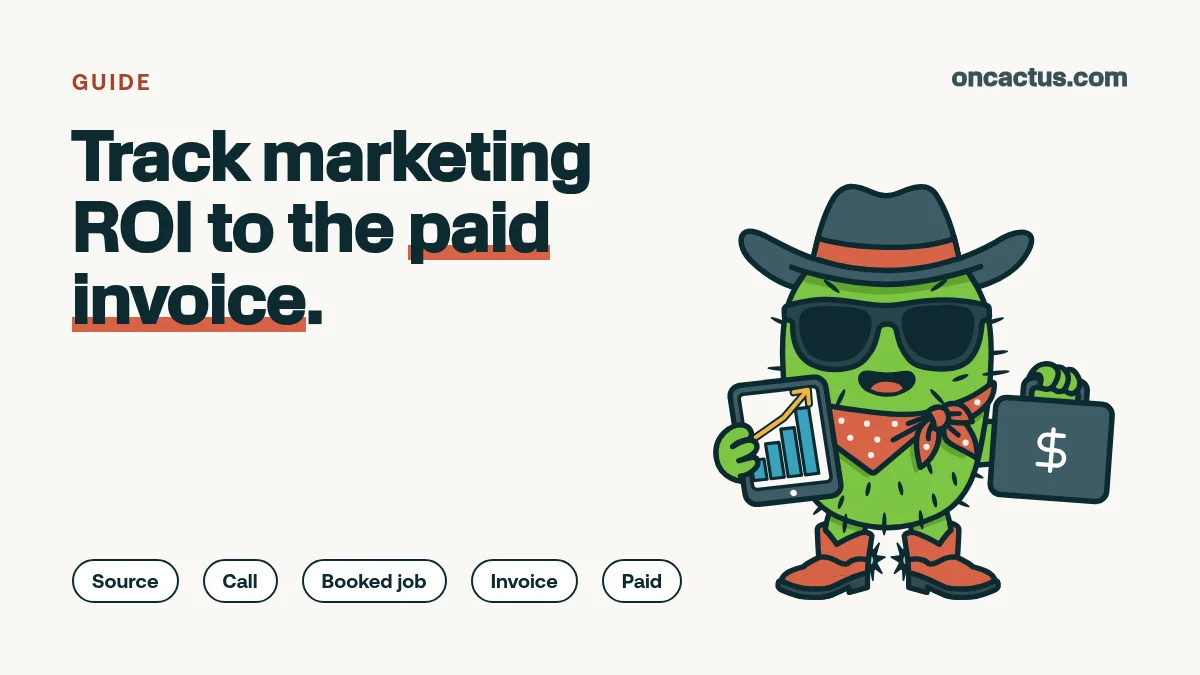
Most home service owners can tell you what they spent on marketing last month. Far fewer can tell you which of those dollars came back as paid work. The gap is not a lack of data. It is that the data lives in three places that never talk to each other: the ad platform, the phone, and the invoice.
This guide walks through a simple way to close that gap. No new dashboard required, just a clear chain from first contact to money in the bank.
Why clicks and calls are the wrong finish line
Ad platforms grade themselves on clicks, form fills and calls. Those are useful early signals, but they stop at the exact moment your business starts doing the work:
- A call is not a job. Some callers are existing customers, some are vendors, some are spam, and some are tire-kickers who never book.
- A booked job is not revenue. Estimates go unsold, jobs get cancelled, and some invoices take weeks to get paid.
- The lag hides the truth. In roofing and replacement work, the homeowner who called this month may sign next month. A report that only looks at one month will undercount the channel that actually produced the job.
If your marketing report ends at “calls,” you are measuring the cost side of the ledger and guessing at the revenue side.
The chain you actually want to measure
Think of every job as a chain with five links. If any link is missing, the dollar cannot be traced back.
- Source. Where the customer first found you: a search ad, a local listing, a yard sign, a referral, a past-customer message.
- First contact. The call, text or form, with the customer’s phone number attached.
- Booked work. The job or estimate created in Housecall Pro, Jobber, AccuLynx, JobNimbus or whatever runs your schedule.
- Invoice. What you billed for that customer.
- Paid. What actually cleared.
The link that holds everything together is the customer’s phone number. It is on the call record, it is on the customer record in your field software, and it is on the invoice. Matching on it is not glamorous, but it is reliable.
How to set it up with what you already have
Give each marketing source its own number or tag. Use a separate tracking number per major channel, or at least tag web forms by source. If a channel has no way to identify itself, you will never be able to credit it.
Make sure every call lands somewhere you can read later. A call that goes to an owner’s cell phone and never gets logged is invisible. Every inbound call should leave a record with the caller’s number, the time, and what they needed.
Create the customer in your field software on the first call, not the first visit. If the record starts at the estimate, you have already lost the link back to where the call came from.
Once a month, match invoices to first contact. Pull the month’s invoices, look up each customer’s phone number in your call records, and note the first time that number called and which source it came through. That is your traced revenue by channel.
Look back further than one month. For longer sales cycles, count customers who first called in earlier months too. In the Gaston Roofing case study, 13 of the 30 customers behind a single month of traced invoices had first called before that month. A one-month window would have missed almost half of them.
What a traced month looks like
Here is what this looks like when it is done carefully. Each of these comes from a published Cactus case study, measured by matching a single month of invoices to call records by the customer’s phone number:
- Roofing: Gaston Roofing traced 31 invoices and $144,394 in billed work to calls Cactus handled.
- Plumbing: Upfront Plumbing traced 40 invoices and $95,690 in billed work.
- HVAC: Mighty Air traced 50 invoices and $36,226 in billed work.
The point is not the size of the numbers. It is that each one is a count of real invoices tied to real calls, not an estimate built from clicks.
Mistakes that make ROI look better or worse than it is
- Counting spam and existing customers as leads. Screen them out before you compare channels, or your cheapest channel will look like your best one.
- Crediting the last touch only. A homeowner may find you through a search ad, then call back later from a postcard. Keep the first source on the record.
- Ignoring unsold estimates. An open estimate is revenue the marketing already paid for. If nobody follows up, it shows up as bad ROI when it is really a follow-up problem. More on that in where booked jobs actually leak.
- Ignoring after-hours calls. If nights and weekends go to voicemail, the channels that drive evening calls will look weak for reasons that have nothing to do with the marketing. See what happens when the phone goes to voicemail.
Where Cactus fits
Cactus is the operations partner for home service businesses. We answer and log every call, book work into the tools you already use, follow up on open estimates, and match paid invoices back to the calls we handled. That is also how we get paid: we only get paid when you do, on jobs we can trace back to Cactus. So we are on your side of the table when it comes to knowing which marketing actually pays.
If you want to see what this looks like for your shop, book a demo, or read what an operations partner is first.